April 11, 2008
1 min read
 Add Us On GoogleAdd SciAm
Phobos in Stereo
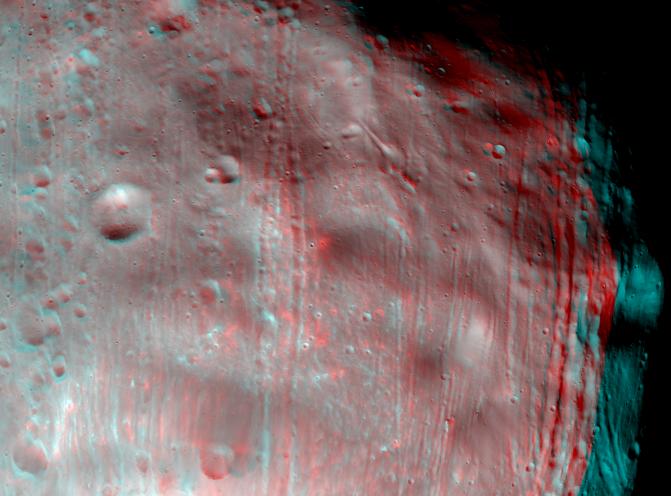
Behold the latest B-movie horror! Not really. It's just Phobos, the larger and inner of Mars's two moons, in a new image captured by instruments on NASA's Mars Reconnaissance Orbiter on March 23 from a distance of 6,800 kilometers (4,200 miles).
On supporting science journalism
If you're enjoying this article, consider supporting our award-winning journalism by subscribing. By purchasing a subscription you are helping to ensure the future of impactful stories about the discoveries and ideas shaping our world today.
Behold the latest B-movie horror! Not really. It's just Phobos, the larger and inner of Mars's two moons, in a new image captured by instruments on NASA's Mars Reconnaissance Orbiter on March 23 from a distance of 6,800 kilometers (4,200 miles). Researchers operating the craft's High Resolution Imaging Science Experiment (HiRISE) combined this snapshot with a second one, taken 10 minutes later, to generate a stereo view suitable for the drive-in (available here). The oblong moon measures some 22 kilometers (14 miles) in length and the image has a resolution of about 15 meters (50 feet), according to NASA. Researchers say that information gleaned from the flyby may help them to understand the origin and evolution of the moon, which is thought to be rich in ice and carbon compounds. The picture reveals that material around the rim of Stickney crater, the moon's largest surface feature [lower right], appears bluer than its surroundings, suggesting that it hasn't been exposed to space for as long. Also visible are landslides, grooves and crater chains illuminated by sunlight reflected from Mars.
It’s Time to Stand Up for Science
If you enjoyed this article, I’d like to ask for your support. Scientific American has served as an advocate for science and industry for 180 years, and right now may be the most critical moment in that two-century history.
SciAm always educates and delights me, and inspires a sense of awe for our vast, beautiful universe. I hope it does that for you, too.
If you subscribe to Scientific American, you help ensure that our coverage is centered on meaningful research and discovery; that we have the resources to report on the decisions that threaten labs across the U.S.; and that we support both budding and working scientists at a time when the value of science itself too often goes unrecognized.
In return, you get essential news, captivating podcasts, brilliant infographics, can't-miss newsletters, must-watch videos, challenging games, and the science world's best writing and reporting. You can even gift someone a subscription.
There has never been a more important time for us to stand up and show why science matters. I hope you’ll support us in that mission.