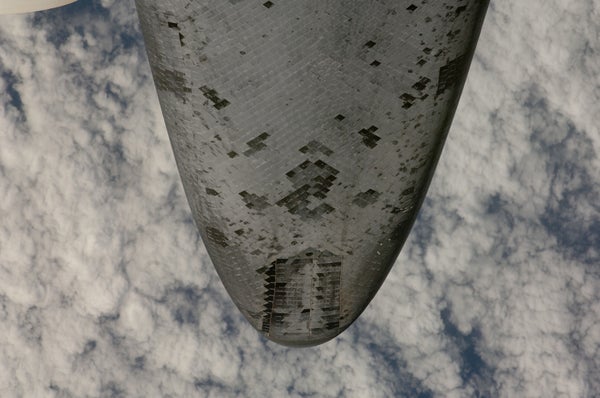
Photo of space shuttle's belly shows dings
Before docking with the International Space Station (ISS) on Friday, space shuttle Endeavour performed a backflip maneuver so that crew members on the station could check the shuttle's heat shield for damage.
On supporting science journalism
If you're enjoying this article, consider supporting our award-winning journalism by subscribing. By purchasing a subscription you are helping to ensure the future of impactful stories about the discoveries and ideas shaping our world today.
Before docking with the International Space Station (ISS) on Friday, space shuttle Endeavour performed a backflip maneuver so that crew members on the station could check the shuttle's heat shield for damage. Earlier in the week, as the shuttle lifted off from Kennedy Space Center in Florida, pieces of foam insulation fell off the orbiter's external fuel tank, striking the shuttle and carving small nicks (white specks on right edge) into several of the tiles that make up the thermal shield.
ISS commander Gennady Padalka and flight engineer Michael Barratt photographed the shuttle from about 180 meters away Friday, producing high-resolution imagery that mission managers on the ground analyzed to gauge the risk to the shuttle and crew on reentry. NASA personnel have said that the damage, as seen in the photographs and in a robotic-arm survey of the heat shield performed en route to the ISS, appears relatively benign.
It’s Time to Stand Up for Science
If you enjoyed this article, I’d like to ask for your support. Scientific American has served as an advocate for science and industry for 180 years, and right now may be the most critical moment in that two-century history.
SciAm always educates and delights me, and inspires a sense of awe for our vast, beautiful universe. I hope it does that for you, too.
If you subscribe to Scientific American, you help ensure that our coverage is centered on meaningful research and discovery; that we have the resources to report on the decisions that threaten labs across the U.S.; and that we support both budding and working scientists at a time when the value of science itself too often goes unrecognized.
In return, you get essential news, captivating podcasts, brilliant infographics, can't-miss newsletters, must-watch videos, challenging games, and the science world's best writing and reporting. You can even gift someone a subscription.
There has never been a more important time for us to stand up and show why science matters. I hope you’ll support us in that mission.