
Very little inspires curiosity like the prospect of exploring alien worlds. A crewed mission to Mars will one day surely captivate the world, just as people walking on the Moon did 50 years ago. But we do not need to leave Earth to go where few have before. The ocean is an unexplored world right on our doorstep.
“Think of how much of our planet is blue,” Sylvia Earle, explorer in residence at the US National Geographic Society in Washington DC, said to attendees of the 69th Lindau Nobel Laureate Meeting in Germany in July. “Most of you have been 11 kilometres up in the sky. But only four people in history have been 11 kilometres down.”
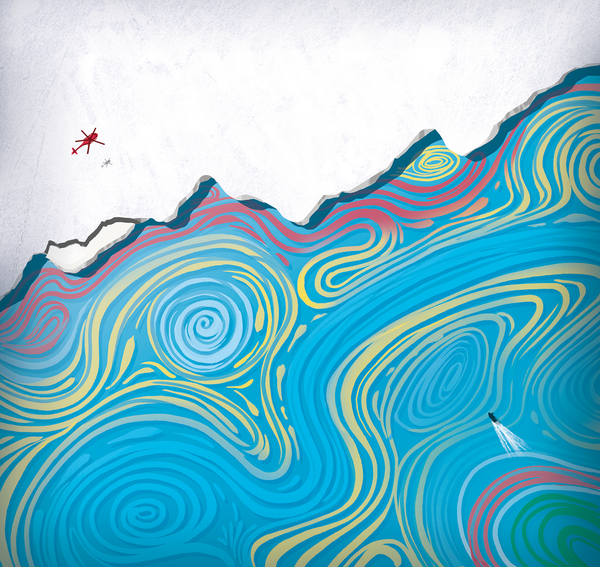
Scientists’ understanding of the physical processes in the ocean is slowly deepening. Networks of floats and moorings provide researchers with a record of the motion of the ocean stretching back several decades. Satellite observations also chart our changing seas. On the cover of this Outlook, artist Sam Falconer uses a plot of global mean sea-level data collected by satellites between February 2017 and June 2019 to represent the jagged edge of the ice shelf. Sea level has risen by about 15 millimetres in that time, and the rate of sea-level rise is increasing (see go.nature.com/33w9isk).
On supporting science journalism
If you're enjoying this article, consider supporting our award-winning journalism by subscribing. By purchasing a subscription you are helping to ensure the future of impactful stories about the discoveries and ideas shaping our world today.
Melting ice sheets are key drivers of sea-level rise. “Antarctica has huge potential to contribute to sea-level rise,” says Marilena Oltmanns, an oceanographer at the National Oceanography Centre in Southampton, UK, “but there are so many unknowns about the ocean circulation” around the southern continent. Researchers are using a variety of techniques to observe the ocean beneath and around ice shelves to better understand the likely impacts of climate change.
But observations alone are not enough—ocean modelling is also required. Some researchers are boosting the resolution of simulations of ocean circulation to improve the accuracy of climate predictions.
Climate change presents a pressing need to understand the ocean better. “This is the first generation to know what the problems are,” Earle says, “and the last generation to be able to do something about it.”
We are pleased to acknowledge the financial support of Mars, Incorporated in producing this Outlook. As always, Nature has sole responsibility for all editorial content.