
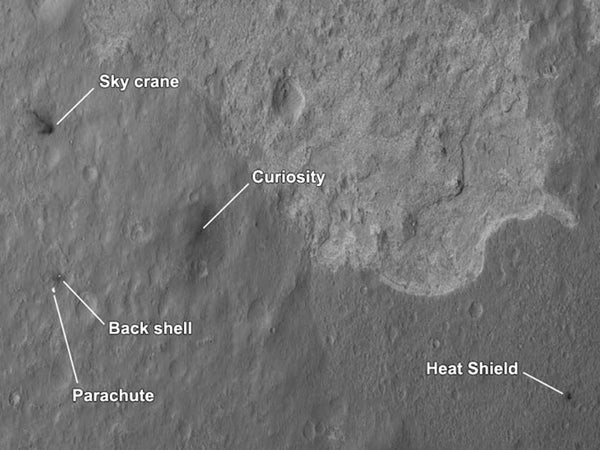
NASA's Mars Reconnaissance Orbiter, which yesterday delivered a stunning photo of the Curiosity rover descending on its parachute toward a safe landing, has followed up with another look at the mobile laboratory.
The orbiter's High-Resolution Imaging Science Experiment camera, or HiRISE, can zoom in on Mars to photograph surface features less than a meter in length. HiRISE's superior visual acuity has enabled it to spot other small Mars robots, such as NASA's Spirit and Opportunity rovers, even as it zooms along in orbit some 300 kilometers overhead.
Curiosity, at three meters long and 2.8 meters wide, is nearly twice the length of Spirit or Opportunity. So HiRISE was able to photograph the newly arrived Curiosity, along with the discarded rocket-powered platform (the "sky crane") that had lowered the rover to the surface. Also visible in the photo is the spacecraft's thermal shield, which protected the rover from intense friction-generated heat during its entry into the Martian atmosphere at more than 20,000 kilometers per hour, as well as the parachute that further slowed the rover's entry before the sky crane took over.
On supporting science journalism
If you're enjoying this article, consider supporting our award-winning journalism by subscribing. By purchasing a subscription you are helping to ensure the future of impactful stories about the discoveries and ideas shaping our world today.
The massive rover touched down at 1:31 A.M. Eastern Daylight Time on August 6, beginning its mission of exploration at Gale Crater. Inside the 150-kilometer-wide basin, Curiosity will investigate the chemical and geologic record of Mars's past climate, with an eye toward determining whether the Red Planet was ever hospitable to life.