Pig-Size South American Rodent Spotted in Central California

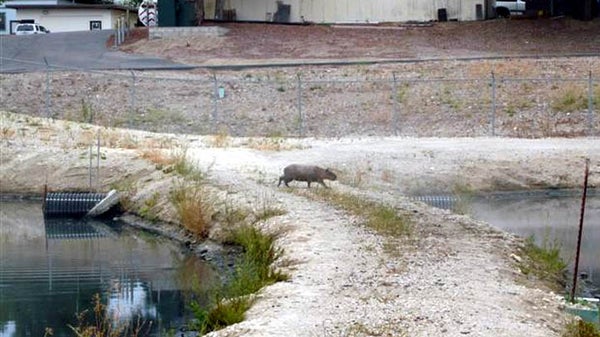
Nick Kamp , who works at a water treatment plant in Paso Robles , Calif., was near a solid-waste pond when he spotted something emerging from the murky water.

Courtesy Nick Kamp/KSBY/KION

Join Our Community of Science Lovers!

Nick Kamp, who works at a water treatment plant in Paso Robles, Calif., was near a solid-waste pond when he spotted something emerging from the murky water. He quickly snapped a few photos of what turned out to be a capybara, the world's largest rodent, before it slipped back into the water and swam away.

Capybaras resemble huge guinea pigs and can grow to be as large as sheep, sometimes reaching more than 1.3 meters in length. They eat grass, freshwater plants and—to aide digestion—their own feces. The semiaquatic mammals are native to South American marshlands and swamps, but this sighting in central California was not the first.

Three years ago, a capybara sighting at a nearby golf course was dismissed as a probable beaver misidentification, but the hulking rodent later showed up chasing a farm dog, whose owner tried unsuccessfully to shoot the wild animal. California Department of Fish and Game official Todd Tognazzini told local TV news reporters that he suspects people are seeing the same capybara in each incident, and that it's most likely an escaped exotic pet.


On supporting science journalism

If you're enjoying this article, consider supporting our award-winning journalism by subscribing. By purchasing a subscription you are helping to ensure the future of impactful stories about the discoveries and ideas shaping our world today.


This sighting was the first caught on film.

Lauren F. Friedman

It’s Time to Stand Up for Science

If you enjoyed this article, I’d like to ask for your support. Scientific American has served as an advocate for science and industry for 180 years, and right now may be the most critical moment in that two-century history.

I’ve been a Scientific American subscriber since I was 12 years old, and it helped shape the way I look at the world. SciAm always educates and delights me, and inspires a sense of awe for our vast, beautiful universe. I hope it does that for you, too.

If you subscribe to Scientific American, you help ensure that our coverage is centered on meaningful research and discovery; that we have the resources to report on the decisions that threaten labs across the U.S.; and that we support both budding and working scientists at a time when the value of science itself too often goes unrecognized.

In return, you get essential news, captivating podcasts, brilliant infographics, can't-miss newsletters, must-watch videos, challenging games, and the science world's best writing and reporting. You can even gift someone a subscription.

There has never been a more important time for us to stand up and show why science matters. I hope you’ll support us in that mission.

Thank you,

David M. Ewalt, Editor in Chief, Scientific American

Subscribe