
Scientists once thought bigger brains made smarter animals. But birds fly in the face of that logic: with a brain smaller than a walnut, they can develop sophisticated tools and remember where they hid food. Now research published in Current Biology suggests birds can pull this off because their brain neurons use less energy than those of mammals, letting their bodies support a higher proportion of these cells.
A 2016 study showed that avian brains are denser than those of many other animals. For example, a macaw’s 20-gram brain holds as many neurons as a squirrel monkey’s 30-gram brain. But neurons drain energy; researchers have found that a human brain uses a fifth of the body’s energy despite being only 2 percent of its mass, notes avian neuroscientist Kaya von Eugen of Ruhr University Bochum in Germany. She and others wondered how birds’ small bodies and energy budgets—based on how much food they consume—can support so many neurons.
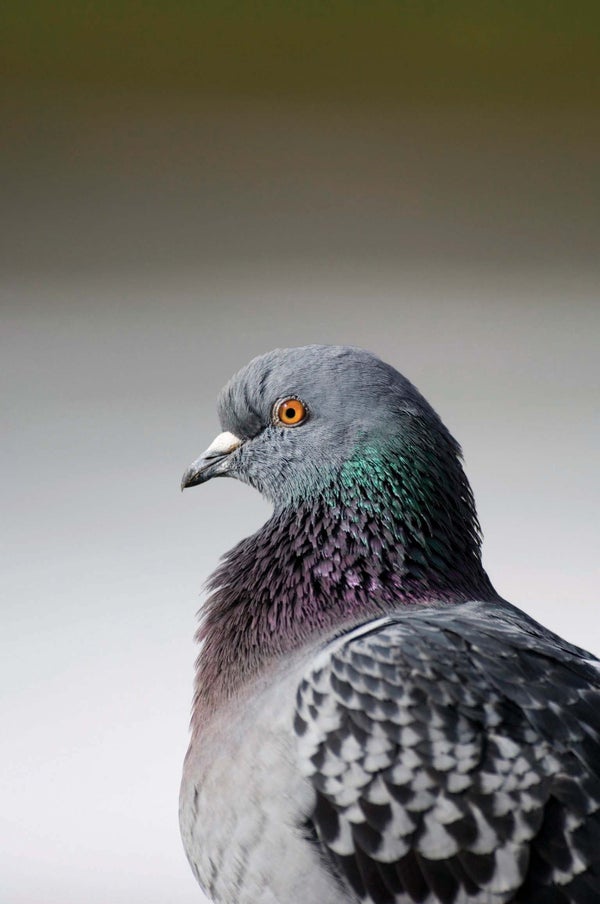
To find out, the researchers turned to the common pigeon. They injected glucoselike molecules marked with a radioactive chemical into the veins of 10 pigeons, then used a scanner to track the radioactivity as it moved through the birds’ brains. By examining this movement and taking blood samples, the researchers determined how much glucose each gram of brain tissue consumed. Then, using neurons-per-gram data from the 2016 paper, they calculated how much glucose each neuron used every minute.
On supporting science journalism
If you're enjoying this article, consider supporting our award-winning journalism by subscribing. By purchasing a subscription you are helping to ensure the future of impactful stories about the discoveries and ideas shaping our world today.
When compared against the neuronal energy budget of rodents, humans and other primates, a pigeon neuron used three times less energy than the average mammal’s neuron—a “really surprising” result, von Eugen says. Although avian neurons are likely smaller than a typical mammal’s, she adds, the difference in energy use “is so big that this cannot be the only explanation.” Perhaps, she suggests, avian brains are organized so that neurons can more easily exchange signals, or maybe birds’ warmer body temperatures let neurons function faster. The authors speculate that complex cognitive needs such as song and flight could have pushed the evolution of more efficient brain cells.
The finding is “pretty remarkable,” says Vanderbilt University neuroscientist Suzana Herculano-Houzel, who worked on the 2016 study but was not involved in the new research. Based on the density disparities between mammal and bird brains, she says, the energy difference is “exactly the math you’d expect.” Birds may have evolved this trait simply to work with their limited energy supply, Herculano-Houzel adds, rather than to accommodate advanced processing needs.
Both Herculano-Houzel and von Eugen are curious about neuron energy use in other birds; von Eugen is particularly interested in chickens, crows, parrots and even birds’ closest living relatives on the tree of life—crocodiles.