
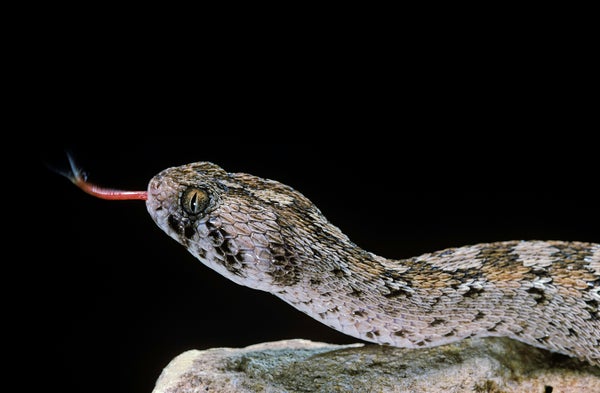
A drug that treats poisoning from heavy metals may also offer a fighting chance at surviving a venomous snakebite. In a study published in May in Science Translational Medicine, researchers show that oral doses of the medication can reduce viper venom's effects in mice.
Saw-scaled or carpet vipers are a group of aggressive venomous snake species found in Asia and Africa, including some densely populated regions with limited access to modern medical facilities. “They arguably cause more bites and deaths than any other snake in the world,” says Abdulrazaq Habib, an infectious and tropical disease physician at Nigeria's Bayero University Kano, who was not involved in the study. The vipers' venom destroys tissue around the bite site and sometimes leads to loss of digits, limbs or lives, Habib adds.
This venom contains toxic enzymes called metalloproteinases, which rely on zinc ions to function and can cause tissue damage and internal bleeding. “We hypothesized that capturing these ions may inhibit the toxin's activity and neutralize its harmful effects,” says Laura-Oana Albulescu, a biochemist at the Liverpool School of Tropical Medicine (LSTM) in England and lead author on the new study. She and her colleagues investigated treatments for poisoning from heavy metals that use compounds to clamp onto loose metal ions. “We hope our study will highlight the promise of repurposing oral treatments as first-line interventions for snakebite—an idea that has been tinkered with before ... but was never fully developed,” Albulescu says.
On supporting science journalism
If you're enjoying this article, consider supporting our award-winning journalism by subscribing. By purchasing a subscription you are helping to ensure the future of impactful stories about the discoveries and ideas shaping our world today.
The researchers' laboratory tests showed that a family of three promising drugs could inhibit the toxin's activity in venoms from multiple species of saw-scaled vipers. Next they tested each drug in mice injected with a typically lethal dose of venom from a West African carpet viper. One drug, unithiol, saved all mice when given 15 minutes after venom injection and followed an hour after injection by an antivenom dose. Neither the drug nor antivenom alone was sufficient to save all the envenomated mice, Albulescu says. The results suggest unithiol might work as an early snakebite intervention, buying more time to reach a hospital for treatment. “The findings reported are very promising, and the investigators have explored different practical scenarios,” Habib says.
The drug costs much less than antivenom and is already designated safe for other uses, says Nicholas Casewell, a study co-author and venom expert at LSTM. The researchers plan to begin clinical trials in humans early next year to verify the drug's safety and tolerability in African populations, who bear the brunt of viper attacks. Their hope is that within a couple of years unithiol might become the world's first “snakebite pill.”