November 28, 2011
1 min read
 Add Us On GoogleAdd SciAm
Pilots Brave Snow, Grizzlies to Find 1948 Plane Wreckage
Half a century after Northwest Airlines Flight 4422 slammed into the side of 4,950-meter Mount Sanford in eastern Alaska's Wrangell Mountains, killing all 30 men on board, commercial pilots Kevin McGregor and Marc Millican found the wreckage embedded in a glacier.
Half a century after Northwest Airlines Flight 4422 slammed into the side of 4,950-meter Mount Sanford in eastern Alaska's Wrangell Mountains, killing all 30 men on board, commercial pilots Kevin McGregor and Marc Millican found the wreckage embedded in a glacier.
The debris had been quickly covered by snow and ice at the time and so had never been recovered. McGregor and Millican studied maps and historical accounts to calculate where on one of several glaciers they thought the impact had occurred. Then they estimated how far the debris field might have traveled as the glacier moved down the mountain. Because their searches from the air revealed nothing, they undertook several dangerous treks up onto the glacier to see if they could find what was left of the plane.
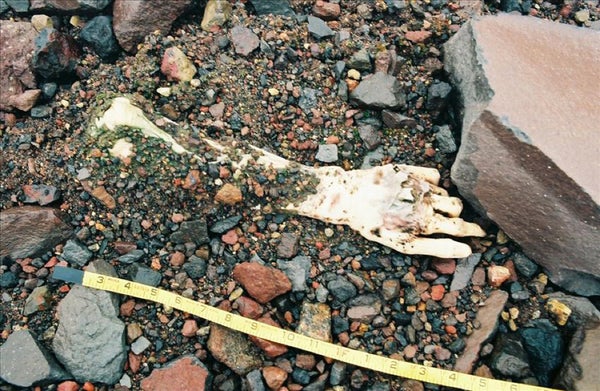
On one of their visits to the site after locating the wreckage, they found a severed human arm complete with its hand embedded in the ice. View this audio slide show to hear McGregor talk about the quest while viewing photos taken during the climbs to find the wreckage of NW 4422.
On supporting science journalism
If you're enjoying this article, consider supporting our award-winning journalism by subscribing. By purchasing a subscription you are helping to ensure the future of impactful stories about the discoveries and ideas shaping our world today.
» Watch the audio slide show
It’s Time to Stand Up for Science
If you enjoyed this article, I’d like to ask for your support. Scientific American has served as an advocate for science and industry for 180 years, and right now may be the most critical moment in that two-century history.
SciAm always educates and delights me, and inspires a sense of awe for our vast, beautiful universe. I hope it does that for you, too.
If you subscribe to Scientific American, you help ensure that our coverage is centered on meaningful research and discovery; that we have the resources to report on the decisions that threaten labs across the U.S.; and that we support both budding and working scientists at a time when the value of science itself too often goes unrecognized.
In return, you get essential news, captivating podcasts, brilliant infographics, can't-miss newsletters, must-watch videos, challenging games, and the science world's best writing and reporting. You can even gift someone a subscription.
There has never been a more important time for us to stand up and show why science matters. I hope you’ll support us in that mission.