On supporting science journalism
If you're enjoying this article, consider supporting our award-winning journalism by subscribing. By purchasing a subscription you are helping to ensure the future of impactful stories about the discoveries and ideas shaping our world today.
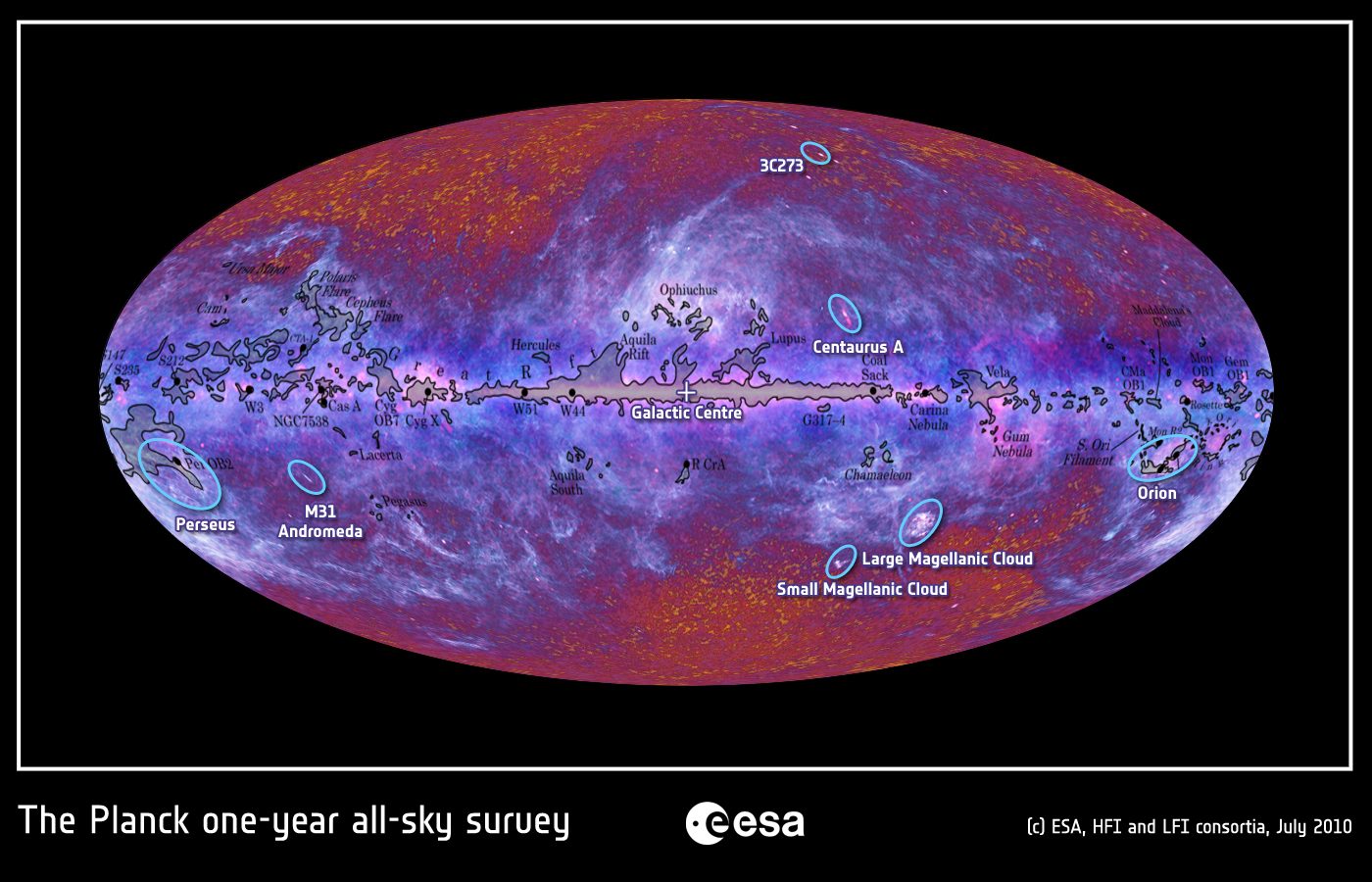
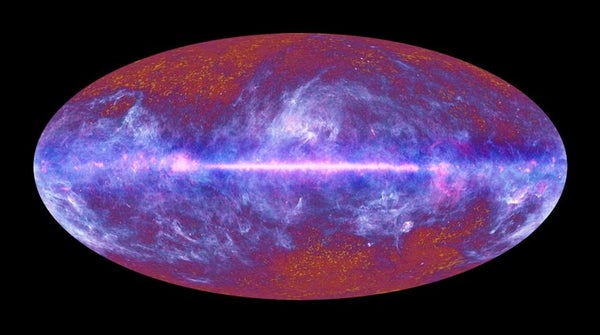
The European Space Agency's Planck mission team has released the spacecraft's first full map, charting the entire sky from August 2009 to June 2010. The image, centered on the plane of the Milky Way Galaxy, represents wavelengths from microwave to far infrared.
The Andromeda Galaxy appears as a small diagonal streak on the left side of the map, below the Milky Way's galactic plane, and bright smudges below center on the right side mark two other galactic neighbors, the Large and Small Magellanic clouds. (Click here for a labeled map.)
Toward the top and bottom of the map, away from the foreground structures of the Milky Way and its companion galaxies, is the cosmic microwave background (CMB) radiation, remnant light emitted 380,000 years after the big bang. An earlier NASA satellite, the Wilkinson Microwave Anisotropy Probe (WMAP), uncovered a bounty of cosmological data by measuring subtle temperature fluctuations across the CMB, and Planck promises to take an even closer look, potentially providing a test of key cosmological theories.
Now that Planck has mapped the sky, the hard work begins; researchers must painstakingly remove the foreground light sources to get a clear view of the cosmic microwave background. According to a news release from NASA, a participant in the mission, the process will take about two years.