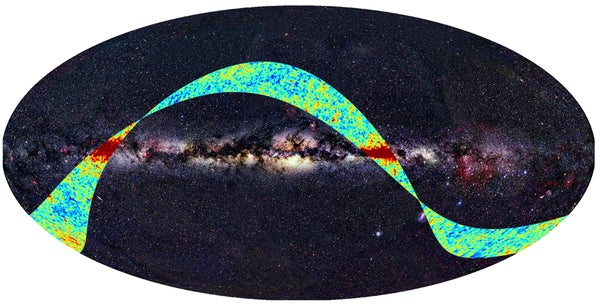
Planck, an observatory stationed in space beyond the Earth–moon system, has begun its task of probing the universe as it looked when it was just a sliver of its present age .
ESA, LFI & HFI Consortia. Background optical image: Axel Mellinger
Join Our Community of Science Lovers!
On supporting science journalism
If you're enjoying this article, consider supporting our award-winning journalism by subscribing. By purchasing a subscription you are helping to ensure the future of impactful stories about the discoveries and ideas shaping our world today.
Planck, an observatory stationed in space beyond the Earth–moon system, has begun its task of probing the universe as it looked when it was just a sliver of its present age. Last month the European Space Agency probe started to map the cosmic microwave background, the relic radiation from the early universe, taking this "first light" survey between August 13 and August 27. (Planck's preliminary data are superimposed on an optical-light image of the sky.) As the spacecraft spins and follows its loop around the sun, it will build a complete map of the sky in about half a year.
The cosmic microwave background is a wash of electromagnetic radiation that has been propagating through the universe for more than 13 billion years. It contains information about the state of the universe about 380,000 years after the big bang, when the background radiation was emitted. By measuring subtle temperature differences across the microwave background (indicated by color variations in Planck's map), astronomers can see what kind of universe this relic light emanated from.
A similar probe launched in 2001, NASA's Wilkinson Microwave Anisotropy Probe (WMAP), helped nail down the age of the universe as well as the relative abundances of ordinary matter, dark matter and dark energy. Planck will build on those WMAP observations and provide data to test competing theories of inflation, the hypothesized rapid expansion of the universe that followed hot on the heels of the big bang.
Subscribe to Support Independent Journalism
Great science journalism requires human expertise, time, effort and creativity. And it costs money. That’s why I and the journalists here at Scientific American hope you’ll join our community.
When you subscribe, you are supporting staff and freelance journalists who are passionate about telling science stories that are true, important and compelling. Our editors and reporters are often experts in their fields, which means they understand the nuances of big discoveries and can untangle the breakthroughs from the hype. With a subscription, you are also supporting rigorous fact-checking to ensure the words we publish are precise and accurate. And you’re supporting original illustrations, graphics and photos that bring you closer to an advanced laboratory, an ice sheet in Antarctica or a space mission in orbit. You’re helping us craft other types of high-quality journalism as well: Our newsletters are carefully written, edited and curated by staffers you have or will come to know and love. Our Science Quickly podcast is based on original reporting, collaboration with editors and scientists and exacting production.
Subscriptions keep this engine running so we can continue to deliver thoughtful, rigorous and independent science journalism to you. In an era of viral misinformation, this work is crucial. If you value what we do, I hope you’ll consider joining us as a subscriber
Thank you,
Jeanna Bryner, Editor in Chief, Scientific American