
The Diamond Princess cruise ship. A Georgetown church in Washington, D.C. A Latin American restaurant in Raleigh, North Carolina. A hotel in Oklahoma City. Two Broadway theaters in New York City.
All announced that they’ve undergone a “deep clean” in recent weeks after discovering that a person infected with the novel coronavirus had been there.
They are just the tip of a pile of businesses and consumer gathering spots that say they are stepping up cleaning protocols.
On supporting science journalism
If you're enjoying this article, consider supporting our award-winning journalism by subscribing. By purchasing a subscription you are helping to ensure the future of impactful stories about the discoveries and ideas shaping our world today.
While cleaning for the coronavirus is not that different from disinfecting for other viruses, like the flu or a common cold, industries are tailoring the cleaning in keeping with what makes sense for them. Public health officials suggest a few common steps can be used by both businesses and individual households: increasing the frequency of cleanings, using disinfectant products that federal officials say are effective, cleaning “high-touch” spots and making hand sanitizer readily available.
But there is no universal protocol for a “deep clean” to eradicate the coronavirus. Ridding it from smooth surfaces is easier than getting it out of upholstery or carpeting, for instance. And the key to eliminating the spread of the virus hinges on good hygiene practices.
“No cleaning protocol is perfect,” said Benjamin Lopman, an associate professor of epidemiology at Emory University in Atlanta. But combining cleaning with other public health initiatives, such as social distancing, “will act in concert hopefully in reducing the transmission of the coronavirus,” he added.
Deep cleaning is not a scientific concept and likely means something different to individual businesses or consumers. The Centers for Disease Control and Prevention has issued guidelines for community facilities that have had people with suspected or confirmed coronavirus disease, called COVID-19. It recommends that “high-touch” surfaces be disinfected daily.
But not all forms of infection control are the same. Disinfectants kill germs on a surface. Cleaning can remove ― but not necessarily kill—viruses. Sanitizing refers to lowering the number of infectious agents to a safe level through cleaning or disinfecting an area.
The Environmental Protection Agency has released a list of registered cleaning products that work against hardier germs and are presumed to be good options to fight the novel virus, said Karen Hoffmann, the immediate past president of the Association for Professionals in Infection Control and Epidemiology.
“This virus is actually very sensitive to all the common cleaning and disinfecting agents out there, so that’s the good news,” said Hoffmann.
Businesses and others respond in unique ways.
Delta Airlines now uses foggers to spray a mist of disinfectant on surfaces throughout the cabin on all trans-Pacific flights arriving in the U.S. and flights from Italy landing in certain American airports, its website says. It plans to extend the procedure to trans-Atlantic flights coming from areas with reported cases of COVID-19.
American Airlines stated that on international flights it is disinfecting items like glasses and cutlery before regular washing. And Southwest Airlines said it now uses a hospital-grade disinfectant throughout the plane during overnight cleaning instead of its former practice of using that only in select areas like the restroom.
The Carnival Corp., which runs Carnival Cruise Lines, Holland America Line, Princess Cruises and others, said it is suspending cruises through April 9. The company said it has amped up efforts to clean ships, including increasing the temperature at which bedding, napkins, towels and tablecloths are washed and using “electro-static applications through specialized machines” for deep cleanings to be conducted at night.
Schools are shutting their doors to students and also promising to clean their facilities to prevent the spread of COVID-19.
A spokesperson for the American Hospital Association said that while frequent cleaning is standard, hospitals are giving special attention to “high-touch surfaces such as in-room phones, TV/nurse calls, light switches and cords, handles, drawer pulls, bed rails, tray tables and bathroom fixtures.”
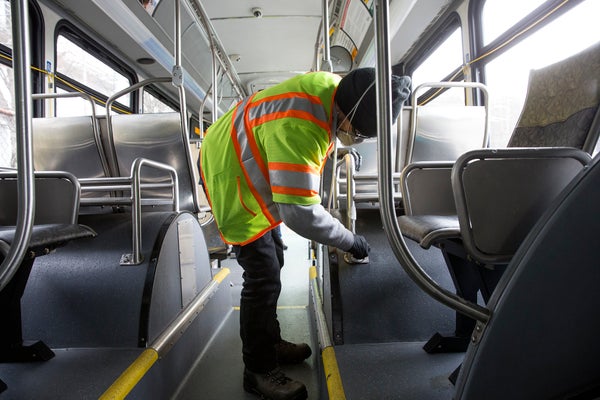
Sound Transit, which runs a regional public transportation service in the Seattle-Tacoma, Washington, metropolitan area, has increased the number of times it cleans its vehicles, a spokesperson said.
Bay Area Rapid Transit (BART), the train and bus authority in the San Francisco Bay Area, is installing hand sanitizer dispensers at each of its 48 stations, the general manager said in a recent board meeting. While six Bay Area counties implement a “shelter in place” order for the next three weeks, BART says it plans to continue regular service while increasing disinfection of the trains and allowing for riders to maintain social distancing on platforms and in train cars.
WMATA, the public transit authority servicing the Washington, D.C., area, has stepped up cleaning and cut back train service as part of its pandemic response.
Gyms and workout classes—if they haven’t closed—are notifying members that they are cleaning handles and flat surfaces in common areas, moving equipment and workstations to create more space among clients and adding time to workout classes to ensure that every piece of equipment that is touched is wiped down after use.
Even Lime, an electric scooter rental company, sent an email to customers suggesting they consider disinfecting scooter handles before riding. The company also said on their website that it increased the number of times they clean and disinfect their scooters.
Cleaning may need to be geared to specific surfaces, Lopman said.
The coronavirus appears to live on surfaces for hours and perhaps up to days, CDC stated on its website. Still, the agency said it has not documented any cases of COVID-19 from a person touching a contaminated area. The virus appears to be spreading more often from person to person through droplets produced when someone coughs or sneezes.
Consumers should read the directions on cleaning products for information about how long it needs to be in contact with germs in order to work effectively. If those instructions list a time range, “you should use the longest contact time specified on the product label,” said Komal Jain, executive director of the Center for Biocide Chemistries at the American Chemistry Council.
If traditional cleaning products are in short supply in your area, there are other ways to prevent the spread of germs, said Hoffmann. Hydrogen peroxide can be used to clean surfaces. Soap and water, using some “elbow grease,” or a washing machine can remove germs as well, she said.
Items can also be taken outside and placed in the sun.
“Viruses don’t like UV light,” she said. “They don’t like sunshine.”
This story was originally published by Kaiser Health News on March 17, 2020. Read the original story here.
Read more about the coronavirus outbreak here.