Planet-Hunting Kepler Telescope Wakes Up, Phones Home

Nearing the end of its life, the spectacularly successful mission is still churning out new observations

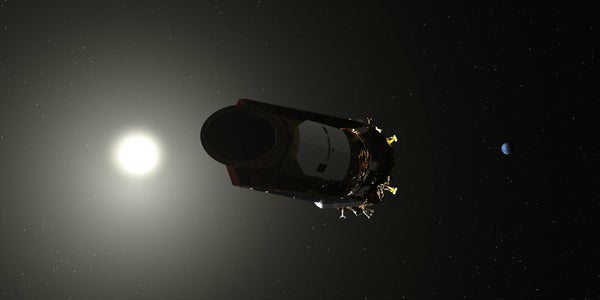
Running low on fuel, the Kepler space telescope recently revived from a state of hibernation, transmitting data to Earth in preparation for doing more great science.

Join Our Community of Science Lovers!

The Kepler space telescope isn't dead yet.

Kepler, which has discovered about 70 percent of the 3,800 known exoplanets to date, woke up from a four-week hibernation yesterday (Aug. 2) and has begun beaming data home, just as planned, NASA officials announced today (Aug. 3).

Kepler had been sleeping in an attempt to save thruster fuel, which is running very low. Mission team members wanted to make sure the spacecraft had enough propellant left to orient its antenna toward Earth for yesterday's data dump. 


On supporting science journalism

If you're enjoying this article, consider supporting our award-winning journalism by subscribing. By purchasing a subscription you are helping to ensure the future of impactful stories about the discoveries and ideas shaping our world today.


Far-flung NASA spacecraft send information back to mission controllers via the agency's Deep Space Network (DSN), a system of radio dishes around the globe. The sun-orbiting Kepler's latest allotted DSN window opened yesterday, agency officials have said.

The $600 million Kepler mission launched in March 2009, tasked with helping determine how common Earth-like planets are throughout the Milky Way galaxy. The spacecraft hunts for alien worlds by noticing the tiny brightness dips caused when the exoplanets cross their host stars' faces from Kepler's perspective.

During its original mission, Kepler stared continuously at 150,000 stars, gathering data that would lead to more than 2,300 confirmed exoplanet finds (and counting). These observations ceased in May 2013, when the second of Kepler's four orientation-maintaining reaction wheels failed, robbing the spacecraft of its precise pointing ability.

But the mission team figured out a way to stabilize Kepler using sunlight pressure, and in 2014, NASA green-lit an extended mission called K2. During K2, Kepler observes a variety of cosmic phenomena during shifting 80-day "campaigns." Some campaigns involve exoplanet hunts; the K2 alien-world tally currently stands at 323. 

Kepler has completed 18 campaigns to date during its K2 mission phase. Campaign 19 will start Monday (Aug. 6), if enough fuel remains after the current data-delivery work. So stay tuned! 

Copyright 2018 SPACE.com, a Purch company. All rights reserved. This material may not be published, broadcast, rewritten or redistributed.

Mike Wall has been writing for Space.com since 2010. His book about the search for alien life, “Out There,” was published on Nov. 13, 2018. Before becoming a science writer, Michael worked as a herpetologist and wildlife biologist. He has a Ph.D. in evolutionary biology from the University of Sydney, Australia, a bachelor’s degree from the University of Arizona, and a graduate certificate in science writing from the University of California, Santa Cruz.

More by Mike Wall

SPACE.com is the premier source of space exploration, innovation and astronomy news, chronicling (and celebrating) humanity's ongoing expansion across the final frontier.

More by SPACE.com

It’s Time to Stand Up for Science

If you enjoyed this article, I’d like to ask for your support. Scientific American has served as an advocate for science and industry for 180 years, and right now may be the most critical moment in that two-century history.

I’ve been a Scientific American subscriber since I was 12 years old, and it helped shape the way I look at the world. SciAm always educates and delights me, and inspires a sense of awe for our vast, beautiful universe. I hope it does that for you, too.

If you subscribe to Scientific American, you help ensure that our coverage is centered on meaningful research and discovery; that we have the resources to report on the decisions that threaten labs across the U.S.; and that we support both budding and working scientists at a time when the value of science itself too often goes unrecognized.

In return, you get essential news, captivating podcasts, brilliant infographics, can't-miss newsletters, must-watch videos, challenging games, and the science world's best writing and reporting. You can even gift someone a subscription.

There has never been a more important time for us to stand up and show why science matters. I hope you’ll support us in that mission.

Thank you,

David M. Ewalt, Editor in Chief, Scientific American

Subscribe