
On supporting science journalism
If you're enjoying this article, consider supporting our award-winning journalism by subscribing. By purchasing a subscription you are helping to ensure the future of impactful stories about the discoveries and ideas shaping our world today.
Earlier this year the scientists of NASA's Kepler mission announced that their planet-hunting space telescope had identified more than 1,200 possible exoplanets (worlds orbiting stars other than our own sun) in its first few months on the job.
The potential planets Kepler has located range from worlds a bit smaller than Earth all the way up to giants several times the size of Jupiter. Similarly, some of the host stars are several times as large as the sun whereas some are much smaller.
Follow-up and validation will be required before astronomers can firmly proclaim that the candidates are real planets and not some other phenomenon tricking Kepler's electronic eye. In the meantime, a member of the Kepler team has assembled a visualization of all the promising objects seen so far by the telescope—a variety of stars partially shadowed by a variety of likely planets. (Kepler spots exoplanets by tracking more than 150,000 stars, watching each for slight but periodic dimming that might indicate the presence of an orbiting companion passing in front of the star. The goal is to locate potentially habitable Earth-like worlds.)
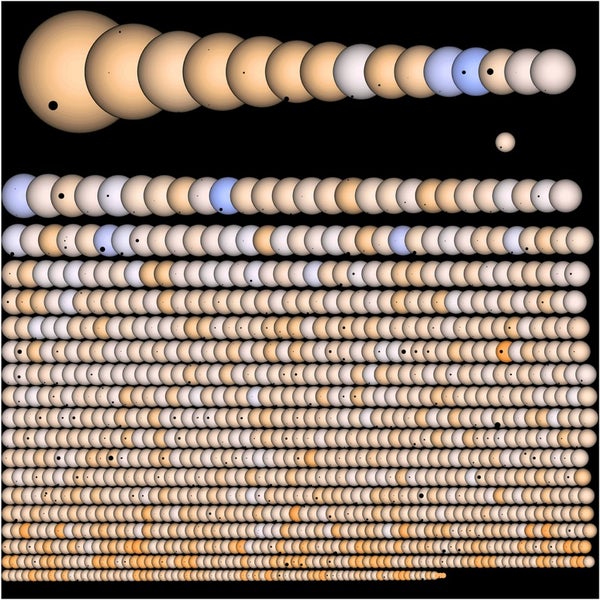
To make the image above, Jason Rowe of NASA Ames Research Center laid out by size all of the stars in Kepler's field of view that appear to host planets, along with tiny dark spots to indicate the relative size of the planetary candidate (or candidates) in orbit there. All stars and planets are to scale.
The lone star in the upper right is not in Kepler's field of view; it is included for comparison only. That star is the sun; the dark shadow on its face is Jupiter. In an enlarged version of Rowe's solar diagram the tiny shadow of Earth is visible as well. That graphic makes plain the difficulty of Kepler's task—to identify Earth-size worlds orbiting sunlike stars only by the minuscule dimming effects those planets have on the much larger stars. But the mission is well on its way, and may in just a few years' time have identified the first Earth twins outside the solar system.