Plant Strife: Satellite measurements show declining phytoplankton in ocean currents

How green is Earth? That's a question that NASA's Sea-viewing Wide Field-of-view-Sensor Project, known as SeaWiFS, has been asking for the past 13 years.

Jesse Allen, using data provided courtesy of the Ocean Color Web team

Join Our Community of Science Lovers!


On supporting science journalism

If you're enjoying this article, consider supporting our award-winning journalism by subscribing. By purchasing a subscription you are helping to ensure the future of impactful stories about the discoveries and ideas shaping our world today.


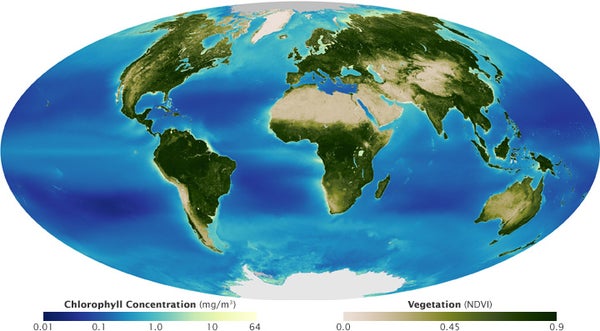
How green is Earth? That's a question that NASA's Sea-viewing Wide Field-of-view-Sensor Project, known as SeaWiFS, has been asking for the past 13 years. This image shows SeaWiFS' average measurements from 1998 to 2010.

SeaWiFS, on board the OrbView 2 (aka SeaStar) satellite measures the wavelengths of light reflected by phytoplankton (microscopic marine plants) and algae that use chlorophyll for photosynthesis. Over the oceans, SeaWiFS data indicate the concentration of phytoplankton floating on the surface. Scanning land, the sensor calculates the density of vegetation as a normalized difference vegetation index (NDVI). An NDVI of 0 means no green leaves, whereas an NDVI near 1.0 indicates a thick forest.

SeaWiFS data show that photosynthesizing organisms have declined in certain ocean gyres (large-scale surface current patterns), said Jim Yoder, a scientist at the Woods Hole Oceanographic Institution, in a NASA article commemorating the end of SeaWiFS's mission. (The instrument stopped communicating with Earth in December 2010 and its operators officially ended the mission in February.)

Scientists are still debating whether the decline is due to natural ocean cycles or climate change.

—Francie Diep

It’s Time to Stand Up for Science

If you enjoyed this article, I’d like to ask for your support. Scientific American has served as an advocate for science and industry for 180 years, and right now may be the most critical moment in that two-century history.

I’ve been a Scientific American subscriber since I was 12 years old, and it helped shape the way I look at the world. SciAm always educates and delights me, and inspires a sense of awe for our vast, beautiful universe. I hope it does that for you, too.

If you subscribe to Scientific American, you help ensure that our coverage is centered on meaningful research and discovery; that we have the resources to report on the decisions that threaten labs across the U.S.; and that we support both budding and working scientists at a time when the value of science itself too often goes unrecognized.

In return, you get essential news, captivating podcasts, brilliant infographics, can't-miss newsletters, must-watch videos, challenging games, and the science world's best writing and reporting. You can even gift someone a subscription.

There has never been a more important time for us to stand up and show why science matters. I hope you’ll support us in that mission.

Thank you,

David M. Ewalt, Editor in Chief, Scientific American

Subscribe