
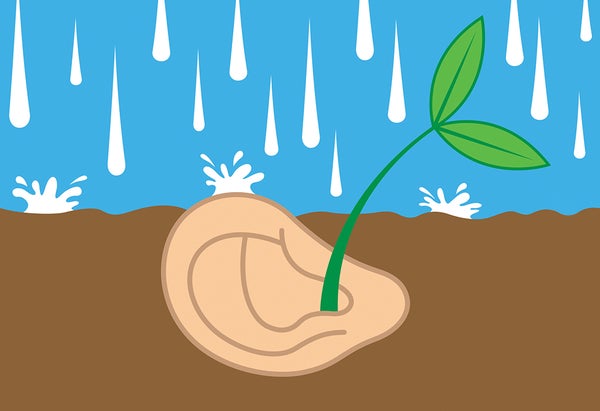
Rain sounds may be soothing for humans, but for plants the pitter-patter of droplets is more like a jarring morning alarm. As water falls onto soil or more water, the vibrations are far stronger underground than on the surface, and new research suggests plants take advantage of this wake-up call.
The sound of rain causes rice seeds to sprout faster than they would otherwise, according to a study published in Scientific Reports. The results mark the first direct evidence that plants sense and respond to sounds in their environment, the researchers say. And it’s likely that seeds from other plant species behave in the same way.
“It is a little bit of an unusual, quirky effect” that only an interdisciplinary effort between acoustic and plant scientists could have uncovered, says study lead author Nicholas C. Makris, a mechanical engineer who researches acoustics and sensing at the Massachusetts Institute of Technology.
On supporting science journalism
If you're enjoying this article, consider supporting our award-winning journalism by subscribing. By purchasing a subscription you are helping to ensure the future of impactful stories about the discoveries and ideas shaping our world today.
Just how much plants can sense in the world around them has long puzzled researchers. There’s evidence to suggest that plants might have the ability to “think,” “see,” “hear” and make sounds, but scientists have only rarely observed a cause-and-effect relation that reveals our flora friends responding to their environment in real time. In the new study, the researchers home in on the link between sound and germination.

Rice plants sense the sound vibrations of raindrops hitting the ground—and researchers suspect other plants can do the same.
Pornpimon Koonhom/Getty Images
In plants, cellular structures called statoliths are responsible for external sensing. These structures are envelopes of starch that shift and settle at the bottom of plant cells, helping the organisms to detect changes in their position and stability—and to tell germinating seeds in which direction to grow their roots. Makris and study co-author Cadine Navarro, then a graduate student in urban studies at M.I.T., theorized that rain sounds underwater might produce large enough vibrations to jostle the statoliths and possibly prompt germination in rice seeds.
The scientists exposed about 8,000 rice seeds submerged in water, their preferred growing condition, to rain sounds. They found that the noise made these seeds germinate between 30 and 40 percent faster than seeds that were kept in quiet but otherwise identical conditions.
“I think this paper is a really significant advance in our understanding of how plants respond to the acoustic energy in their environment,” says Heidi Appel, a biologist at the University of Houston, who was not involved in the new work. “This is the first study of its kind to measure the vibrational impact of raindrops carefully and realistically.”
Researchers, including Appel and the study authors, hope these findings will be an “aha! moment” for future scientists, inspiring them to study plants’ responses to other natural sounds.