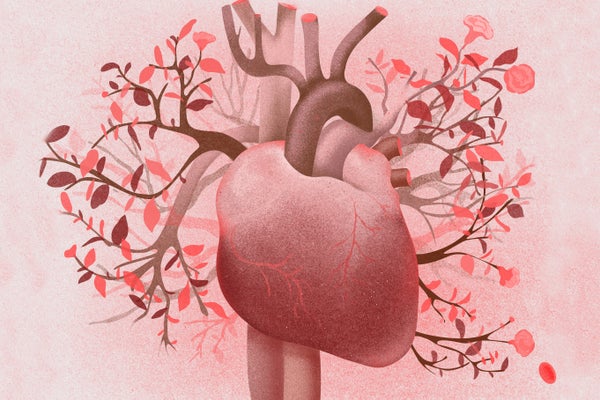
Poem: ‘Cardiac Knotting’

Science in meter and verse

The heart growing on a vine.

Masha Foya

Join Our Community of Science Lovers!

Edited by Dava Sobel

The heart will have no interruption,
begins as a simple tube  (blood flow undivided)
at the middle of embryo
hurried—task of branching sufficient blood
levels into all upcoming situations.  (in-roads throughout the growing body)

The heart, quick, outgrows its own
allotted cavity, and bends a branch right  (every time)
and back—pivots into
the cardiac loop, plotting
pistons, to hang self-knotting,
strung-up. The blood muscle must
raise divisions. The hollow heart


On supporting science journalism

If you're enjoying this article, consider supporting our award-winning journalism by subscribing. By purchasing a subscription you are helping to ensure the future of impactful stories about the discoveries and ideas shaping our world today.


now split, turns intrinsic—walling out
a partition, a pocket, a sinus to house
the pulmonary hinges—a body’s
bloodlines soon become confluent  (before bringing back a breath)
to enter the heart.

When later more transitional twisting
has caused a furrow, external,
the interfacing ventricle wall will
thicken—meshwork of muscular
fetters tuck together, reach out,
near-bridge for the atrial pacemaker.
An intra-arterial hollow so self-established.  (lock and chamber)

Meanwhile, against the narrower walls
and paired opposite, loose masses
of migratory tissue  (from the mesoderm)
driven. Could linger on,
the non-particular life of a stem cell.

But here soft commotion reaching out,
endocardial cushions obstruct
the blood rush into opposite corners.
Predestined axes of embryo, peristalsis
in a pre-valved hollow—the body’s
first organ to engine
an animal’s ontogeny,

the heart
as it begins to beat.

John Liles is a poet, science writer and head naturalist at the Pacific Environmental Education Center in northern California. His forthcoming collection, Bees, and After, won the 2024 Yale Younger Poets Prize.

More by John Liles
Scientific American Magazine Vol 332 Issue 1This article was published with the title “Cardiac Knotting” in Scientific American Magazine Vol. 332 No. 1 (), p. 77
doi:10.1038/scientificamerican012025-3BO5DoUdzbzRtgJl7tVnT5

It’s Time to Stand Up for Science

If you enjoyed this article, I’d like to ask for your support. Scientific American has served as an advocate for science and industry for 180 years, and right now may be the most critical moment in that two-century history.

I’ve been a Scientific American subscriber since I was 12 years old, and it helped shape the way I look at the world. SciAm always educates and delights me, and inspires a sense of awe for our vast, beautiful universe. I hope it does that for you, too.

If you subscribe to Scientific American, you help ensure that our coverage is centered on meaningful research and discovery; that we have the resources to report on the decisions that threaten labs across the U.S.; and that we support both budding and working scientists at a time when the value of science itself too often goes unrecognized.

In return, you get essential news, captivating podcasts, brilliant infographics, can't-miss newsletters, must-watch videos, challenging games, and the science world's best writing and reporting. You can even gift someone a subscription.

There has never been a more important time for us to stand up and show why science matters. I hope you’ll support us in that mission.

Thank you,

David M. Ewalt, Editor in Chief, Scientific American

Subscribe