Poem: We Need the Sky

Science in meter and verse

Getty Images

Join Our Community of Science Lovers!


On supporting science journalism

If you're enjoying this article, consider supporting our award-winning journalism by subscribing. By purchasing a subscription you are helping to ensure the future of impactful stories about the discoveries and ideas shaping our world today.


Edited by Dava Sobel

That we need the sky
to tell us we don’t matter
is why, before totality,
we are so giddy and akimbo.
In its random masking,
how shall the Sun disclose its other light?
(We’ve not seen before.) And strange
air, dark and gray and silver
and soft and very precise,
emerges to pool around every
pore and shiver of skin.
Beneath our breathy hollers,
a river runs dark, sprays of pebble
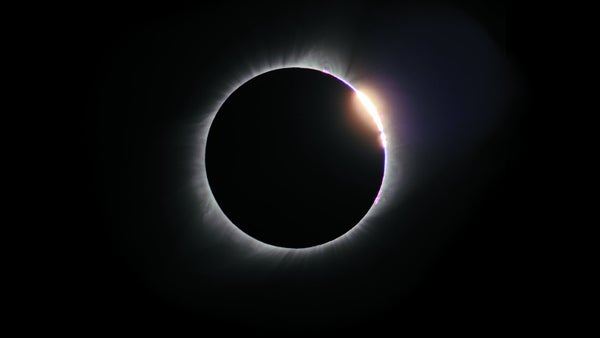
-leaping riffles instantly aloft: Corona
crowns the south: Hole edged
with brimming sprays of light!
What is metaphor but secular alchemy?
Black flat sphere five degrees off the ecliptic
else each month we’d see
totality, normal as a door,
common as a starling.
Above the Little Lost River,
above the valley and its ranges,
above thrall, dumb totality.
And the Moon slips away, unseen, three
millimeters monthly and so on
etcetera till its visage will shirk this scene.
Orbits bloat. Eclipses are happenstance. Like us,
they’ll go extinct, the Moon to be
debris someday, a lovely
ring around a dead Earth.
But, ah, among the living: Crickets
at noon and humans hooting
with an owl, looking for
a gopher or at the light around the Moon:
Pink crust of flares like fire mountains,
like sleep to rub from the Cyclops’s eye
before his hot day at the forge. There is
light around the Moon: White
corona, a hand of streaming cilia
that warns and beckons. The rim brightens,
and fact makes terror wonderful.

Christopher Cokinos is a writer of nonfiction on nature and the environment. His latest book is Still as Bright: An Illuminating History of the Moon, from Antiquity to Tomorrow (Pegasus Books, 2024).

More by Christopher Cokinos
Scientific American Magazine Vol 322 Issue 3This article was published with the title “Eclipse” in Scientific American Magazine Vol. 322 No. 3 (), p. 26
doi:10.1038/scientificamerican0320-26

It’s Time to Stand Up for Science

If you enjoyed this article, I’d like to ask for your support. Scientific American has served as an advocate for science and industry for 180 years, and right now may be the most critical moment in that two-century history.

I’ve been a Scientific American subscriber since I was 12 years old, and it helped shape the way I look at the world. SciAm always educates and delights me, and inspires a sense of awe for our vast, beautiful universe. I hope it does that for you, too.

If you subscribe to Scientific American, you help ensure that our coverage is centered on meaningful research and discovery; that we have the resources to report on the decisions that threaten labs across the U.S.; and that we support both budding and working scientists at a time when the value of science itself too often goes unrecognized.

In return, you get essential news, captivating podcasts, brilliant infographics, can't-miss newsletters, must-watch videos, challenging games, and the science world's best writing and reporting. You can even gift someone a subscription.

There has never been a more important time for us to stand up and show why science matters. I hope you’ll support us in that mission.

Thank you,

David M. Ewalt, Editor in Chief, Scientific American

Subscribe