
Edited by Dava Sobel
She has a map spread at her feet, a lit carpet of gold cities
and silver rivers, each tributary wire-drawn with the tip
of a squirrel's tail. Everything is very damp.
It seems like a dream, even in the dream. Saucers of silk
line the sills like a grand banquet for clothes moths.
The round table (pocked with scorch marks) throngs
On supporting science journalism
If you're enjoying this article, consider supporting our award-winning journalism by subscribing. By purchasing a subscription you are helping to ensure the future of impactful stories about the discoveries and ideas shaping our world today.
with china cups of phosphorus in ether, tin dissolved
in muriatic acid, white oxide of arsenic in—
She tongs sugar lumps, pours the pot. Rainbow bull's-eyes
float in our cups like latte ferns. The ceiling drips.
On the reading stand, a well-thumbed book on phlogiston
is flapping its mildewed wings. The room is strewn
with glittering retorts, cylinders, phials. She wants to know
her name because, for so long, she's been vanishing
by degrees. “The facts of me escape me,” she says.
She lifts the lantern of Dr. Nooth's machine. Iron nails
and diluted sulfuric acid at glass bottom. In the middle,
a ghostly snip of lead-dipped silk dangles over water.
Spangled silver by spindrift, it's the sail of an invisible craft.
There's a puff of white smoke, a never-ending string
of silk swatches from her sleeve. A little goes a long way
and this show might just go until dawn. Now the clouds
are lifting, the wallpaper is rolling back in waves.
It's less drawing room, more Marie Antoinette's bedroom.
In the golden aquatic, our chairs, napkins and clothes blaze
ablaze with shiny, shiny. She says it always consumes her
with wonder, yet her wonder is never consumed.
I imagined in the beginning, that a few experiments would determine the problem
they grow sullen and silent, and are chilled with horror at the sight of any thing
that bears the semblance of learning, in whatever shape it may appear; and should
the specter appear in the shape of woman, the pangs which they suffer are truly dismal
Combustible bodies, as hydrogen, phosphorus, sulfur, charcoal, light, &c.
are capable of reducing the metals in the ordinary temperature of the atmosphere
so that a thimble full of water would be sufficient to reduce any quantity of metal
for this little bark of mine has weathered out full many a storm
repeated times unnumbered so bright and dazzling as to distress the eye
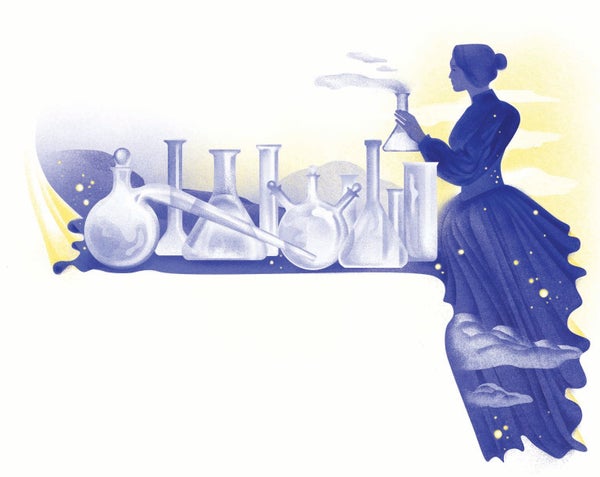
Editor’s Note: In the 18th century chemist Elizabeth Fulhame described the processes that later became known as catalysis and photoreduction. Extracts in italics are from her 1794 work: “An Essay on Combustion with a View to a New Art of Dying and Painting, Wherein the Phlogistic and Antiphlogistic Hypotheses are Proved Erroneous.” This essay was reprinted in 1810 in Philadelphia. It's not known where or when she was born. According to a note by Charles Watt, Fulhame “died in abject poverty in a mean apartment in the vicinity of Soho Square.”