New Issue: Orbital Catastrophe Ahead? Read Now

Poem: ‘In Reality’

Science in meter and verse

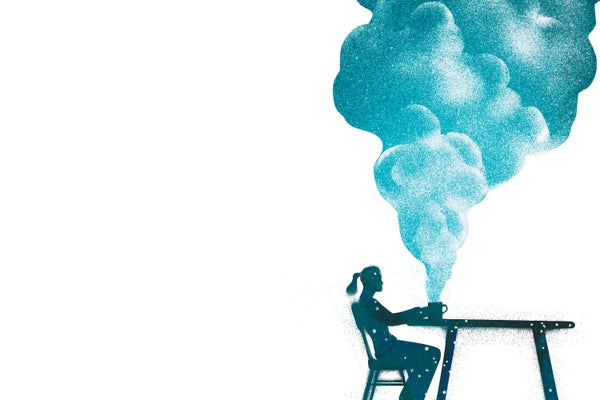
Illustration of a person's silhoutte sitting at a table with a cup of coffee, and the coffee's steam rising into space

Masha Foya

According to astronomers
the universe is 14 billion years old,
a fact that makes the long scroll
of my life—

its fine brushstrokes of autumn leaves, inclining
over a mountain pool; the quick,
inscrutable characters that say
something wise & eternal but look
to me like long-legged insects—

  so infinitesimally short
that, in reality, I cannot be said
to have lived at all;


On supporting science journalism

If you're enjoying this article, consider supporting our award-winning journalism by subscribing. By purchasing a subscription you are helping to ensure the future of impactful stories about the discoveries and ideas shaping our world today.


  not to mention this day,
starting as usual with coffee & a glance
at the shocking headlines, with their promise
of a dire year ahead, which

  cosmologically speaking,
is less than a mole on the cheek of the smallest
unnamed particle skating in an atom of oxygen
exhaled from a single breath of Time;

  much less the hour I’ve sat
pondering this strangeness, while the earth—
still a pudgy adolescent in quantum terms—
turned a little on its axis

  so that sunlight,
which set out a mere 8 minutes ago
on its singular mission to the kitchen table
could brighten the coiled peel of an orange,

  my companion in nothingness,
that has been waiting here
on the saucer beside me
since the beginning.

Jennifer Maier’s collections include Now, Now (2013) and The Occupant (2025), both published by the University of Pittsburgh Press. Maier is a professor of modern literature and poetics at Seattle Pacific University.

More by Jennifer Maier
Scientific American Magazine Vol 333 Issue 4This article was published with the title “In Reality” in Scientific American Magazine Vol. 333 No. 4 (), p. 73
doi:10.1038/scientificamerican112025-6Tx2Cx2GGNeSGncQ6cV7Ab

Subscribe to Support Independent Journalism

Great science journalism requires human expertise, time, effort and creativity. And it costs money. That’s why I and the journalists here at Scientific American hope you’ll join our community.

When you subscribe, you are supporting staff and freelance journalists who are passionate about telling science stories that are true, important and compelling. Our editors and reporters are often experts in their fields, which means they understand the nuances of big discoveries and can untangle the breakthroughs from the hype. With a subscription, you are also supporting rigorous fact-checking to ensure the words we publish are precise and accurate. And you’re supporting original illustrations, graphics and photos that bring you closer to an advanced laboratory, an ice sheet in Antarctica or a space mission in orbit. You’re helping us craft other types of high-quality journalism as well: Our newsletters are carefully written, edited and curated by staffers you have or will come to know and love. Our Science Quickly podcast is based on original reporting, collaboration with editors and scientists and exacting production.

Subscriptions keep this engine running so we can continue to deliver thoughtful, rigorous and independent science journalism to you. In an era of viral misinformation, this work is crucial. If you value what we do, I hope you’ll consider joining us as a subscriber

Thank you,

Jeanna Bryner, Editor in Chief, Scientific American

Subscribe