Poem: Letter to 2050

Science in meter and verse

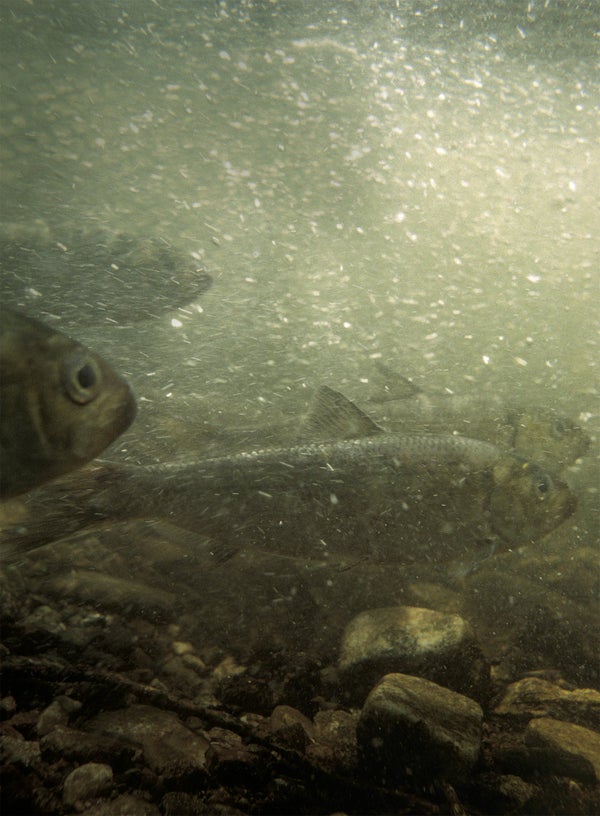
Underwater Art

KC Shields Alamy

Join Our Community of Science Lovers!


On supporting science journalism

If you're enjoying this article, consider supporting our award-winning journalism by subscribing. By purchasing a subscription you are helping to ensure the future of impactful stories about the discoveries and ideas shaping our world today.


Edited by Dava Sobel

The Squamscott River
    grew lazy in early summer—
muskrat rose and dove
    heron swept the air and landed
and hemlocks that had survived
    another century's practice
of harvesting their bark
    were thriving. Some suffered
beaver girdles and the predation
    by woolly adelgids but still
the pileated woodpeckers
    found what they required
in the snags. This is how it was
    for us—pulling threads of hope
out of the air as if we had
    the skill to weave them
back into webs. We surprised
    ourselves when it worked—
so much needed to be undone.
    And I promise you that
as paltry as our efforts
    may seem to you—no.
I won't justify our failures.
    The story of the alewives'
return—that's what I wanted
    you to know because it helps
to think of desires that last
    for centuries without being
satisfied. How far inland
    did the alewives come,
I wondered, the dam removed
    after three hundred years
and in the first year then
    they came in a rush.
Locals could hear the gulls
    gathered in the estuary
in their joy and the alewives
    swam and swam to the reaches
of their ancestors—eleven miles
    and three hundred years
of appetite for place
    their genes remembered
and knew how to find.
    The Abenaki offered
a welcome back ceremony.
    And fishers gathered—human
cat and bird to feast
    and the memory that had been
thwarted for centuries
    became a fertile flow.

Alison Hawthorne Deming is Regents Professor of Creative Writing at the University of Arizona, where she also holds the Agnese Nelms Haury Chair in Environment and Social Justice. She has won many awards for her nonfiction, as well as for her poetry collections, the most recent of which is Stairway to Heaven (Penguin, 2016).

More by Alison Hawthorne Deming
Scientific American Magazine Vol 324 Issue 1This article was published with the title “LETTER TO 2050” in Scientific American Magazine Vol. 324 No. 1 (), p. 22
doi:10.1038/scientificamerican0121-22

It’s Time to Stand Up for Science

If you enjoyed this article, I’d like to ask for your support. Scientific American has served as an advocate for science and industry for 180 years, and right now may be the most critical moment in that two-century history.

I’ve been a Scientific American subscriber since I was 12 years old, and it helped shape the way I look at the world. SciAm always educates and delights me, and inspires a sense of awe for our vast, beautiful universe. I hope it does that for you, too.

If you subscribe to Scientific American, you help ensure that our coverage is centered on meaningful research and discovery; that we have the resources to report on the decisions that threaten labs across the U.S.; and that we support both budding and working scientists at a time when the value of science itself too often goes unrecognized.

In return, you get essential news, captivating podcasts, brilliant infographics, can't-miss newsletters, must-watch videos, challenging games, and the science world's best writing and reporting. You can even gift someone a subscription.

There has never been a more important time for us to stand up and show why science matters. I hope you’ll support us in that mission.

Thank you,

David M. Ewalt, Editor in Chief, Scientific American

Subscribe