Poem: ‘Live and in Color’

Science in meter and verse

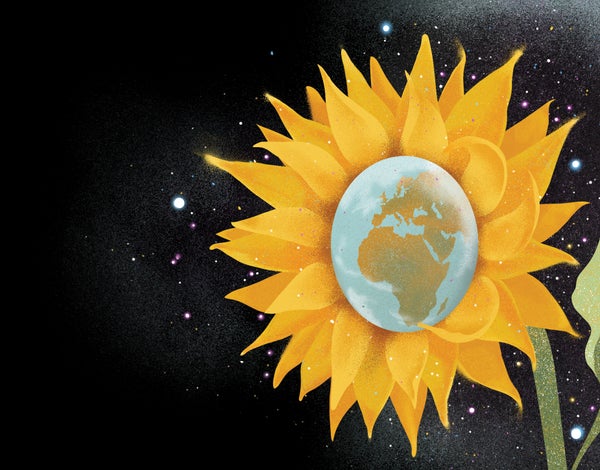
Sunflower with earth in the center of the flower

Masha Foya

Join Our Community of Science Lovers!

In the blink of an eye
the land bloomed with a spectrum of brilliant color
where before it was all greens
   and earth tones.

It was the sudden awakening of a new aesthetic;
our “shrew-like” ancestors, and every creature,
quickly learned to see and enjoy
a palette never before seen.

It was a worldwide revolution of technique and delight
which robustly punctuated
the equilibrium
of evolution.


On supporting science journalism

If you're enjoying this article, consider supporting our award-winning journalism by subscribing. By purchasing a subscription you are helping to ensure the future of impactful stories about the discoveries and ideas shaping our world today.


The knowledge of how to manufacture bold color
gave flowering plants a commanding advantage
   over other plants.
They could now visually signal the animal kingdom
   in a simple and powerful way,
and thereby commandeer legs and wings to carry their pollen.
Flowering species quickly dominated the plant kingdom.
Today 90 percent of plant species are angiosperms.

We associate flowers with nature itself;
   but flowering plants are a johnny-come-lately;
   they are a recent idea.
For 97 percent of Earth’s existence there were no flowers.
For 96 percent of life’s existence there were no flowers.
For 89 percent of the existence of plants there were no flowers.
   A recent idea.

   Animals select their mates based on what they find beautiful,
and so we have all created ourselves in our own image of beauty.
Immediately following the aesthetic revolution brought by the bold colors of flowers,
   small, tree-dwelling dinosaurs,
      not too concerned about staying camouflaged,
         looked at these colors
            and flew with them.

E. M. Teichman is an architect practicing in Sea Bright, N.J. On Sundays, when the firearms are silent, he wanders the hills of eastern Pennsylvania looking for poems.

More by E. M. Teichman
Scientific American Magazine Vol 332 Issue 5This article was published with the title “Live and in Color” in Scientific American Magazine Vol. 332 No. 5 (), p. 87
doi:10.1038/scientificamerican052025-7fvv5Dov1coVJcDrywX1u8

It’s Time to Stand Up for Science

If you enjoyed this article, I’d like to ask for your support. Scientific American has served as an advocate for science and industry for 180 years, and right now may be the most critical moment in that two-century history.

I’ve been a Scientific American subscriber since I was 12 years old, and it helped shape the way I look at the world. SciAm always educates and delights me, and inspires a sense of awe for our vast, beautiful universe. I hope it does that for you, too.

If you subscribe to Scientific American, you help ensure that our coverage is centered on meaningful research and discovery; that we have the resources to report on the decisions that threaten labs across the U.S.; and that we support both budding and working scientists at a time when the value of science itself too often goes unrecognized.

In return, you get essential news, captivating podcasts, brilliant infographics, can't-miss newsletters, must-watch videos, challenging games, and the science world's best writing and reporting. You can even gift someone a subscription.

There has never been a more important time for us to stand up and show why science matters. I hope you’ll support us in that mission.

Thank you,

David M. Ewalt, Editor in Chief, Scientific American

Subscribe