
“[c]learly Rosy had to go or be put in
her place.... The thought could not be
avoided that the best home for a feminist
was in another person’s lab.”
—James D. Watson, The Double Helix (1968)
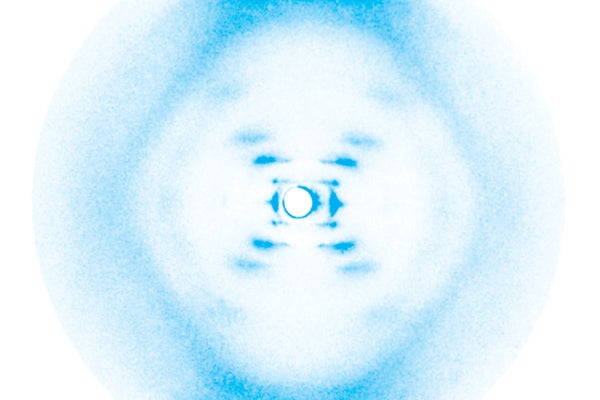
I am the image, that final clue.
I know only this lab, where light can simmer for days,
coaxing shadows to slowly define
the tiny drop you tip so carefully
onto the end of a twisted paperclip.
The lab, and you, squinting into the lens
of a machine you developed—
hydrogen gas pumped through a salt solution—
on the fulcrum between question and discovery.
On supporting science journalism
If you're enjoying this article, consider supporting our award-winning journalism by subscribing. By purchasing a subscription you are helping to ensure the future of impactful stories about the discoveries and ideas shaping our world today.
In the lab, the men call you names, mock your clothes,
your moods, your lips, unpainted.
Your delight, your choice of gardenia
is science.
Not on the first but the fifty-first iteration,
I come to you
in the honey of crystallography
amid x-rays splattered off a fiber of wet DNA
like a tadpole on a sliver of glass.
I swim up, rapt, to visibility.
I whisper my secret only to you,
the clue, first word of the organic story.
The ancient code-script
pinned down at last—
The recipe for whale song
and peacock feathers
earlobe and pea plant, X and Y.
I fix my focus in your eyes, Rose Franklin.
I your discovery. You my laureate.