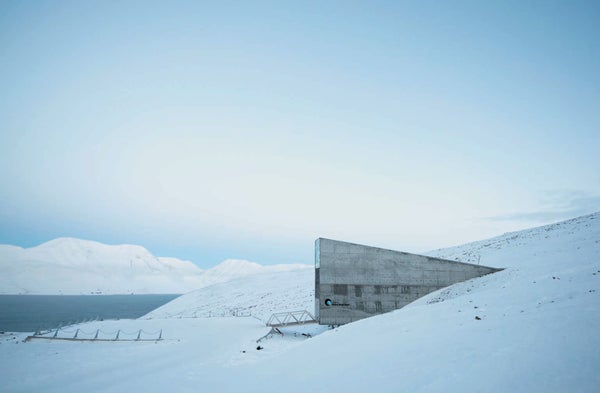
Hoarded at the heart of an Arctic mountain,
within an archipelago of snow: an ark of seeds.
Cocooned against soil, nuclear bodies hunker
and wait for some future hungerscape. A gathering
of crops, varied faces folded into foil,
shuttered from the earth. Lentil, dark and round
and pebble-smooth. Barley's slender husk of an eye.
Each wrinkled chickpea the embryonic head of a bird.
Sister seeds, in Aleppo, shelter abandoned
in the rubble of war. The snow is a silence
except for how the seeds call out to one
another across landmasses that shift and warm.
On supporting science journalism
If you're enjoying this article, consider supporting our award-winning journalism by subscribing. By purchasing a subscription you are helping to ensure the future of impactful stories about the discoveries and ideas shaping our world today.
Svalbard reindeer swivel their ears to listen.
Foxes pause ghostlike on the permafrost.With one
quadrate eye, the vault reflects a frigid blue sea.
Ringed seals bob and dive among the glassy floes.
The vault's stone hull juts like a shipwreck in the drifted
ice while polar bears chuff and lumber past the door.
Inside, thousands upon thousands of promises to feed
what may remain. Doomsday, its other name.
Because we've already planted what's to come.
Edited by Dava Sobel
Subscribe to Support Independent Journalism
Great science journalism requires human expertise, time, effort and creativity. And it costs money. That’s why I and the journalists here at Scientific American hope you’ll join our community.
When you subscribe, you are supporting staff and freelance journalists who are passionate about telling science stories that are true, important and compelling. Our editors and reporters are often experts in their fields, which means they understand the nuances of big discoveries and can untangle the breakthroughs from the hype. With a subscription, you are also supporting rigorous fact-checking to ensure the words we publish are precise and accurate. And you’re supporting original illustrations, graphics and photos that bring you closer to an advanced laboratory, an ice sheet in Antarctica or a space mission in orbit. You’re helping us craft other types of high-quality journalism as well: Our newsletters are carefully written, edited and curated by staffers you have or will come to know and love. Our Science Quickly podcast is based on original reporting, collaboration with editors and scientists and exacting production.
Subscriptions keep this engine running so we can continue to deliver thoughtful, rigorous and independent science journalism to you. In an era of viral misinformation, this work is crucial. If you value what we do, I hope you’ll consider joining us as a subscriber