Poem: ‘Lucy’

Science in meter and verse

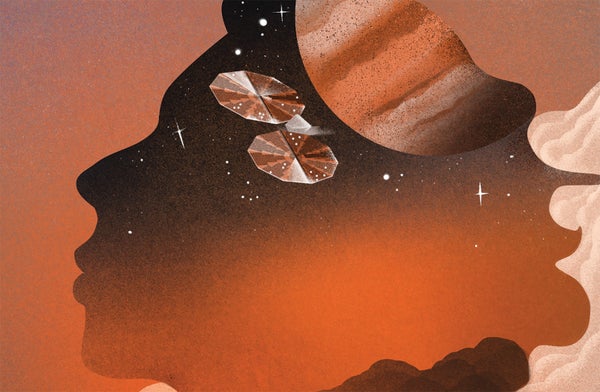
Illustration of a facial profile against a red sky background

Masha Foya

Join Our Community of Science Lovers!

Edited by Dava Sobel

A petite fossilized being of the species
Australopithecus afarensis, she lived
in Ethiopia about three million years ago,
walked upright, three and a half feet tall,
and had a pubic arch similar to that
of a modern woman, but a very small brain.

She was named for the Beatles song
“Lucy in the Sky with Diamonds,”
which was played loudly, over and over
again, in the camp of the anthropologists
who found her in the Awash Valley
of the Afar Triangle at the foot of a gully.


On supporting science journalism

If you're enjoying this article, consider supporting our award-winning journalism by subscribing. By purchasing a subscription you are helping to ensure the future of impactful stories about the discoveries and ideas shaping our world today.


Another Lucy, a chimpanzee born
in 1964, learned American Sign Language.
Using 140 signs, she was interviewed
by the New York Times and invited
the reporter into her tree. He declined.
She could have offered to make him tea.

As an adult, she became destructive
when displeased, so her adoptive parents
sent her for rehabilitation in the jungle
of Gambia, but she was depressed there,
often signing “hurt.” She rejected male
chimpanzees, preferring a human mate.

A space mission to the Trojan asteroids
orbiting the sun with Jupiter is also called
Lucy, after the fossil lady from Africa
whose existence shook up the hominin tree.
Lucy the spacecraft will probe mysteries
of organic chemistry and planet formation.

And what about Lucy, the woman raised
on I Love Lucy, who often hears her name
called at dog parks? She is waiting to learn
how hominins morphed into humans, why
chimps and monkeys don’t talk, and how
worlds bloomed in the field of space.

Lucille Lang Day is the award-winning author or editor of 20 books, including most recently the collection Birds of San Pancho and Other Poems of Place (Blue Light Press, 2020) and the anthology Poetry and Science: Writing Our Way to Discovery (Scarlet Tanager Books, 2021). She is also founder and publisher of Scarlet Tanager Books.

More by Lucille Lang Day
Scientific American Magazine Vol 330 Issue 5This article was published with the title “Lucy” in Scientific American Magazine Vol. 330 No. 5 (), p. 87
doi:10.1038/scientificamerican0524-87

It’s Time to Stand Up for Science

If you enjoyed this article, I’d like to ask for your support. Scientific American has served as an advocate for science and industry for 180 years, and right now may be the most critical moment in that two-century history.

I’ve been a Scientific American subscriber since I was 12 years old, and it helped shape the way I look at the world. SciAm always educates and delights me, and inspires a sense of awe for our vast, beautiful universe. I hope it does that for you, too.

If you subscribe to Scientific American, you help ensure that our coverage is centered on meaningful research and discovery; that we have the resources to report on the decisions that threaten labs across the U.S.; and that we support both budding and working scientists at a time when the value of science itself too often goes unrecognized.

In return, you get essential news, captivating podcasts, brilliant infographics, can't-miss newsletters, must-watch videos, challenging games, and the science world's best writing and reporting. You can even gift someone a subscription.

There has never been a more important time for us to stand up and show why science matters. I hope you’ll support us in that mission.

Thank you,

David M. Ewalt, Editor in Chief, Scientific American

Subscribe