Poem: Other Worlds in Haiku

Science in meter and verse

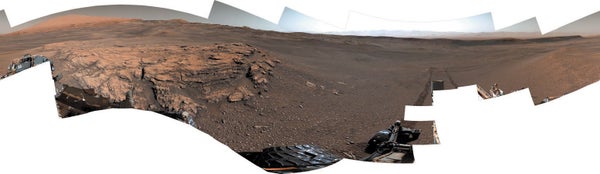
This view of Mars's Teal Ridge was captured by NASA's Curiosity rover in 2019.

Panorama: This view of Mars's Teal Ridge was captured by NASA's Curiosity rover in 2019.

NASA/JPL-Caltech/MSSS

Join Our Community of Science Lovers!

The following haiku, written in the traditional three-line, 17-syllable format by teams of planetary scientists, summarize research results reported at the 52nd Lunar and Planetary Science Conference, which was held virtually March 15–19, 2021.

Detailed Chloride Mapping in Terra Sirenum, Mars

Oceans long since past
Dry, cracked ground, no trace remains
But the taste of salt.


On supporting science journalism

If you're enjoying this article, consider supporting our award-winning journalism by subscribing. By purchasing a subscription you are helping to ensure the future of impactful stories about the discoveries and ideas shaping our world today.


—E. M. Harrington, B. B. Bultel, A. M. Krzesi□nska and S. Werner

Identifying Landing and Sample Tube Depot Sites and Characterizing Traverse Terrains for Mars Sample Return

Three summer interns
Helping a little rover
Return rocks from Mars.

—M. C. Deahn, M. M. Morris, C. L. Brooks, N. R. Williams, M. P. Golombek, F. J. Calef III, S. Do and A. K. Nicholas

“Are Maryland and Other Craters on CCKBO Arrokoth Compaction Craters, and Does it Matter?”

Compaction craters
Explains Arrokoth’s surface
Saves its neck from harm.

—W. B. McKinnon, X. Mao, K. N. Singer, J. T. Keane, P. M. Schenk, O. L. White, R. A. Beyer, S. B. Porter, D. T. Britt, J. R. Spencer, W. M. Grundy, J. M. Moore, S. A. Stern, H. A. Weaver, C. B. Olkin and New Horizons Science Team

“Investigating Icequakes on Enceladus Using an Antarctic Analog: Application of Seismic and Machine-Learning Techniques to Characterize Tidally Induced Seismicity along Icy Rifts”

Antarctic ice quakes
Can this then tell us how does
Enceladus shake?

—K. G. Olsen, N. C. Schmerr, M.-H. Huang, T. A. Hurford and K. M. Brunt

“Seasonal Variability of Titan’s Global Wind Field”

The gales of Titan
Oh, how they blow! What fury!
And how they do change!

—S. L. Light, M. A. Gurwell, C. A. Nixon and A. E. Thelen

Habitability of Cloudy Worlds: Intersecting Constraints and Unknowns

Why clouds are not green:
Where there’s water, there is life*
*Exceptions apply.

—D. M. Gentry, L. Iraci, E. Barth, K. McGouldrick and K.-L. Jessup

Dava Sobel, a former New York Times science reporter, is the author of five books, including the international bestseller Longitude (Walker, 1995). She is the editor of Scientific American's monthly poetry column, Meter.

More by Dava Sobel
Scientific American Magazine Vol 326 Issue 3This article was published with the title “Other Worlds in Few Words” in Scientific American Magazine Vol. 326 No. 3 (), p. 24
doi:10.1038/scientificamerican0322-24

It’s Time to Stand Up for Science

If you enjoyed this article, I’d like to ask for your support. Scientific American has served as an advocate for science and industry for 180 years, and right now may be the most critical moment in that two-century history.

I’ve been a Scientific American subscriber since I was 12 years old, and it helped shape the way I look at the world. SciAm always educates and delights me, and inspires a sense of awe for our vast, beautiful universe. I hope it does that for you, too.

If you subscribe to Scientific American, you help ensure that our coverage is centered on meaningful research and discovery; that we have the resources to report on the decisions that threaten labs across the U.S.; and that we support both budding and working scientists at a time when the value of science itself too often goes unrecognized.

In return, you get essential news, captivating podcasts, brilliant infographics, can't-miss newsletters, must-watch videos, challenging games, and the science world's best writing and reporting. You can even gift someone a subscription.

There has never been a more important time for us to stand up and show why science matters. I hope you’ll support us in that mission.

Thank you,

David M. Ewalt, Editor in Chief, Scientific American

Subscribe