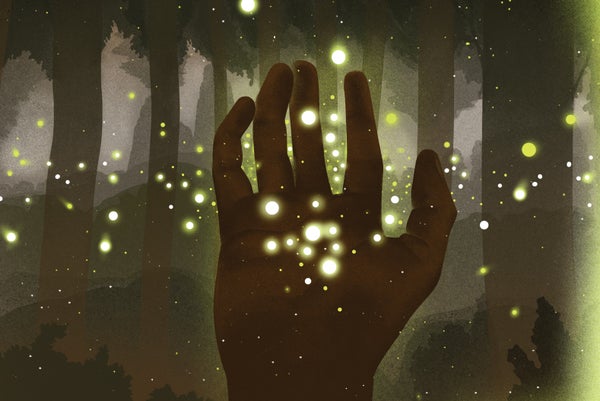
And then: your first light.
Eerie star between metallic, blackened trees.
Your lantern-hum alive like any limb. Any reaching arm
any two hands made cup for stark, elusive beam.
Almost yellow, yet another world’s powdered green.
The snag of something bright but soft within the branches.
Steady moon-waver, otherworldly ash: firefly.
Your glow, a concentrated fog mixed to paint.
Where does the star wander tiny tinkerer
in search of a mate? Luminous engineer,
your body a brilliance unlike anything human.
Better than our best bulbs, and we’ve calculated for centuries.
How different, our energy. How friendly,
the warm-windowed house. Our slow fatality,
a murmured whirl of motors. The way we extinguish you
and barely notice.
On supporting science journalism
If you're enjoying this article, consider supporting our award-winning journalism by subscribing. By purchasing a subscription you are helping to ensure the future of impactful stories about the discoveries and ideas shaping our world today.
Measured insect, with a voice of light between branches—
You are my Lucifer and Venus.
My god of earth, the small fire kindling within.
I’ll follow your low wink
into the woods
past trees, past the hour my house darkens.
Subscribe to Support Independent Journalism
Great science journalism requires human expertise, time, effort and creativity. And it costs money. That’s why I and the journalists here at Scientific American hope you’ll join our community.
When you subscribe, you are supporting staff and freelance journalists who are passionate about telling science stories that are true, important and compelling. Our editors and reporters are often experts in their fields, which means they understand the nuances of big discoveries and can untangle the breakthroughs from the hype. With a subscription, you are also supporting rigorous fact-checking to ensure the words we publish are precise and accurate. And you’re supporting original illustrations, graphics and photos that bring you closer to an advanced laboratory, an ice sheet in Antarctica or a space mission in orbit. You’re helping us craft other types of high-quality journalism as well: Our newsletters are carefully written, edited and curated by staffers you have or will come to know and love. Our Science Quickly podcast is based on original reporting, collaboration with editors and scientists and exacting production.
Subscriptions keep this engine running so we can continue to deliver thoughtful, rigorous and independent science journalism to you. In an era of viral misinformation, this work is crucial. If you value what we do, I hope you’ll consider joining us as a subscriber