
On supporting science journalism
If you're enjoying this article, consider supporting our award-winning journalism by subscribing. By purchasing a subscription you are helping to ensure the future of impactful stories about the discoveries and ideas shaping our world today.
Edited by Dava Sobel
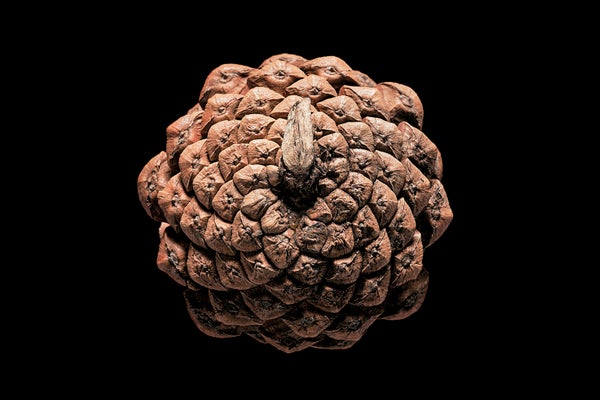
First it fell just fell at my feet no wind no squirrel or bird to give it a push a green green pine cone with brown accents heavy with sealed overlapping rounded rhomboid structures in spirals I have to restrain myself from seeing here the condensed aromatic hydrocarbons I leave it on a plate and look on the web for the names of cone parts names are important even if my last name changed three times what I learn is that I have a female cone that the plates are scales and that each comes in two types bract or seed I think I am seeing seed scales in formation tightly fitting each scale at its center begins to ooze ever-so-slowly a tiny pitch droplet a spiral of spherical diamonds now I know it's pitch and not sap because it is damn sticky I can't get it off my fingers we enter the world of science dealing with the world of words and the world of things being farmed and manufactured and sold sap is not pitch which is not resin-resin and rosin and turpentine and pine tar what's in it for plants is not what's in it for us see water-based sap gets molecule A from site B to C in the inner tree while pitch is an organic soup moving in its own pipelines near the bark ready to flow out if bark or wood is damaged to push out with some force an insect to seal in time forming a solid resin odoriferous to repel insects that might enter the damage or attract some others and we thought we humans made things complicated damned chemist in me can't stop wondering what smells what makes things sticky it's terpenes oligomers of isoprene with appropriate names monoterpenes like pinene and diterpenoid resin acids like abietic acid I could tell you how they're made in pine or the lab and before long we have the whole lovable interconnected and thoroughly messy world meanwhile the cone rests oozing gently maybe the small globules of pitch are a survival strategy to be pollinated by any pollen from male cones that might be left over vain hope wrong season no males and the premature cone begins to darken to brown waiting for dispersal.
Don't let me get started on acorns.