Poem: ‘SnapShot, 1968’

Science in meter and verse

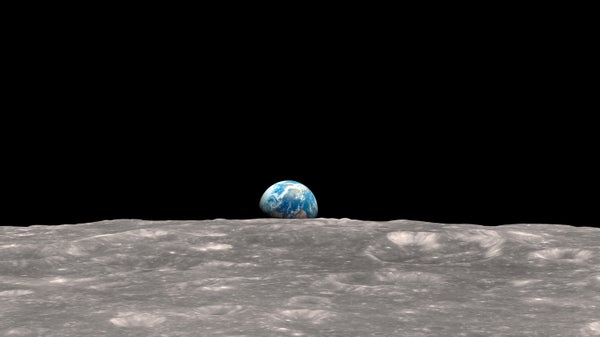
View of Earth from the moon

NASA/Goddard Space Flight Center

Join Our Community of Science Lovers!

Edited by Dava Sobel

From the bright backside of the moon
(never before seen by living eyes
and startled to be so violated)
William Anders, born in Hong Kong
Boy Scout, raised in California
One Holy Catholic & Apostolic pilot
trained to excel floats tumbles shifts
   inside Apollo 8

With a Master of Science in nuclear engineering
the astronaut, authority in dosimetry
radiation effects and environmental control
is in charge of taking lunar pictures *click*
Crater Giordano Bruno *click* Mare Smythii
Apollo’s shadow crawls below lengthens
points: Oh, my God!Look at that ...
There’s the Earth coming up.
   Wow!


On supporting science journalism

If you're enjoying this article, consider supporting our award-winning journalism by subscribing. By purchasing a subscription you are helping to ensure the future of impactful stories about the discoveries and ideas shaping our world today.


For slow as an opening flower
Up up above the barren moonscape
afloat in the stark black void
she silent rises into view
of three men sent to conquer space
and chart the craters of the moon
who now gasp in awe
of newfound recognition:

This planetary marbled cat’s-eye
oceanic atmospheric fragile
this blue pearl set in unforgiving sky
smack in the impossible Goldilocks zone
this mother to 3½ billion people and growing
to 9 million species and dwindling
flecked with oceans and clouds
held in by atmosphere as thin
in proportion as the skin to the apple
alone in all the known universe
   a living planet
      *click-snap*
         is home
      EarthRise!

Gregory Bell, poet, playwright and actor, is the recipient of the 2019 Steve Kowit Poetry Prize and a 2023 Helen Schaible International Sonnet Contest prize. His hybrid poetry collection, Looking for Will: My Bardic Quest with Shakespeare, was published by Ion Drive in 2015.

More by Gregory Bell
Scientific American Magazine Vol 330 Issue 4This article was published with the title “SnapShot, 1968” in Scientific American Magazine Vol. 330 No. 4 (), p. 79
doi:10.1038/scientificamerican0424-8

It’s Time to Stand Up for Science

If you enjoyed this article, I’d like to ask for your support. Scientific American has served as an advocate for science and industry for 180 years, and right now may be the most critical moment in that two-century history.

I’ve been a Scientific American subscriber since I was 12 years old, and it helped shape the way I look at the world. SciAm always educates and delights me, and inspires a sense of awe for our vast, beautiful universe. I hope it does that for you, too.

If you subscribe to Scientific American, you help ensure that our coverage is centered on meaningful research and discovery; that we have the resources to report on the decisions that threaten labs across the U.S.; and that we support both budding and working scientists at a time when the value of science itself too often goes unrecognized.

In return, you get essential news, captivating podcasts, brilliant infographics, can't-miss newsletters, must-watch videos, challenging games, and the science world's best writing and reporting. You can even gift someone a subscription.

There has never been a more important time for us to stand up and show why science matters. I hope you’ll support us in that mission.

Thank you,

David M. Ewalt, Editor in Chief, Scientific American

Subscribe