Poem: Staring at Nothing

Science in meter and verse

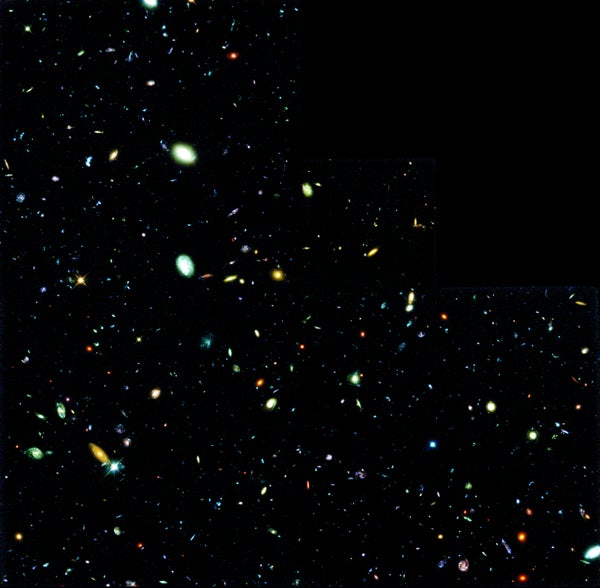
R. Williams STScI , Hubble Deep Field Team, NASA and ESA

Join Our Community of Science Lovers!

—for Dr. Robert Williams, astronomer

Edited by Dava Sobel

What are you staring at? said the mother,
said the cousin, said the teacher to the child—
Nothing, he said. Then his wife asked. Nothing.


On supporting science journalism

If you're enjoying this article, consider supporting our award-winning journalism by subscribing. By purchasing a subscription you are helping to ensure the future of impactful stories about the discoveries and ideas shaping our world today.


Nothing and more nothing and nothing more.
What a waste of time, said his colleagues,
valuable time. People would kill for that.

One December for ten nights and a hundred
hours, he stared at nothing. He looked at where
there wasn't anything but nothing, more nothing,

and nothing more. Nothing but death and birth
merging into light—collisions of blue,
red, yellow, white. Spirals, ellipticals, nothing

but the universe quintupling in size. What wasn't
is teeming with galaxies, gleaming innumerably.
It's nothing, said he. Look at nothing to see.

AUTHOR'S NOTE: In December 1995 astronomer Robert Williams took a risk that was mocked by his colleagues at the Space Telescope Science Institute. As director, Williams used his discretionary time with the Hubble Space Telescope to point at nothing—an apparently empty spot of sky—over a 10-day period. The astounding revelation of thousands of galaxies is now known as the legendary Hubble Deep Field.

Wyatt Townley is Poet Laureate of Kansas Emerita. Her work has been read on NPR, featured in American Life in Poetry, and published in journals, among them North American Review, the Paris Review and the Yale Review. Her latest book of poems is Rewriting the Body (Stephen F. Austin State University Press, 2018).

More by Wyatt Townley
Scientific American Magazine Vol 323 Issue 6This article was published with the title “Staring at Nothing” in Scientific American Magazine Vol. 323 No. 6 (), p. 24
doi:10.1038/scientificamerican1220-24

It’s Time to Stand Up for Science

If you enjoyed this article, I’d like to ask for your support. Scientific American has served as an advocate for science and industry for 180 years, and right now may be the most critical moment in that two-century history.

I’ve been a Scientific American subscriber since I was 12 years old, and it helped shape the way I look at the world. SciAm always educates and delights me, and inspires a sense of awe for our vast, beautiful universe. I hope it does that for you, too.

If you subscribe to Scientific American, you help ensure that our coverage is centered on meaningful research and discovery; that we have the resources to report on the decisions that threaten labs across the U.S.; and that we support both budding and working scientists at a time when the value of science itself too often goes unrecognized.

In return, you get essential news, captivating podcasts, brilliant infographics, can't-miss newsletters, must-watch videos, challenging games, and the science world's best writing and reporting. You can even gift someone a subscription.

There has never been a more important time for us to stand up and show why science matters. I hope you’ll support us in that mission.

Thank you,

David M. Ewalt, Editor in Chief, Scientific American

Subscribe