Poem: ‘The Algorithm’

Science in meter and verse

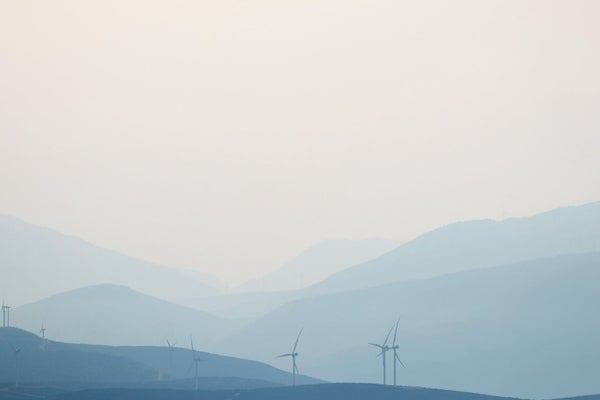
Wind farm.

Nelli Okhrimenko/Getty Images

Join Our Community of Science Lovers!

Edited by Dava Sobel

Optimization under uncertainty
is a field of study in which my grown son
will earn his Ph.D. The math, in his case,
concerns the production of wind energy.

He reads his papers aloud on the phone to me
as a way to optimize their clarity,
so that even a layperson, such as myself,
can understand what he’s saying,
in between each beautifully made
equation and graph.


On supporting science journalism

If you're enjoying this article, consider supporting our award-winning journalism by subscribing. By purchasing a subscription you are helping to ensure the future of impactful stories about the discoveries and ideas shaping our world today.


For me, it’s a matter of optimizing
my time with him, my only child, who lives
so far away and does not get along
with the man I married. I’m looking for
the algorithm that can minimize
the pain entailed for all of us
in this awful situation.

One needs to account for the inconstancy
of the wind’s strength and direction,
and how best to cant the rotors’ turning blades,
and how the power produced is affected
by the wakes created when lots of turbines
are working in concert together.

We stay on the phone for hours sometimes
while I fill my sails with the sweet sounds
of my son’s voice, filled with longing
to hold him close again.

I admire the choice he’s made to apply his gifts
in ways that can make the world a better place,
even though uncertainty is omnipresent,
and must be factored in
to every calculation.

Poet and novelist Barbara Quick lives in northern California. Her 2007 novel, Vivaldi's Virgins, has been translated into a dozen languages and is in development as a miniseries. Her fourth novel, What Disappears, will be published on May 17. Her 2021 chapbook, The Light on Sifnos, won the Blue Light Press Poetry Prize.

More by Barbara Quick
Scientific American Magazine Vol 326 Issue 5This article was published with the title “The Algorithm” in Scientific American Magazine Vol. 326 No. 5 (), p. 24
doi:10.1038/scientificamerican0522-24

It’s Time to Stand Up for Science

If you enjoyed this article, I’d like to ask for your support. Scientific American has served as an advocate for science and industry for 180 years, and right now may be the most critical moment in that two-century history.

I’ve been a Scientific American subscriber since I was 12 years old, and it helped shape the way I look at the world. SciAm always educates and delights me, and inspires a sense of awe for our vast, beautiful universe. I hope it does that for you, too.

If you subscribe to Scientific American, you help ensure that our coverage is centered on meaningful research and discovery; that we have the resources to report on the decisions that threaten labs across the U.S.; and that we support both budding and working scientists at a time when the value of science itself too often goes unrecognized.

In return, you get essential news, captivating podcasts, brilliant infographics, can't-miss newsletters, must-watch videos, challenging games, and the science world's best writing and reporting. You can even gift someone a subscription.

There has never been a more important time for us to stand up and show why science matters. I hope you’ll support us in that mission.

Thank you,

David M. Ewalt, Editor in Chief, Scientific American

Subscribe