Poem: ‘Turing and the Apple’

Science in meter and verse

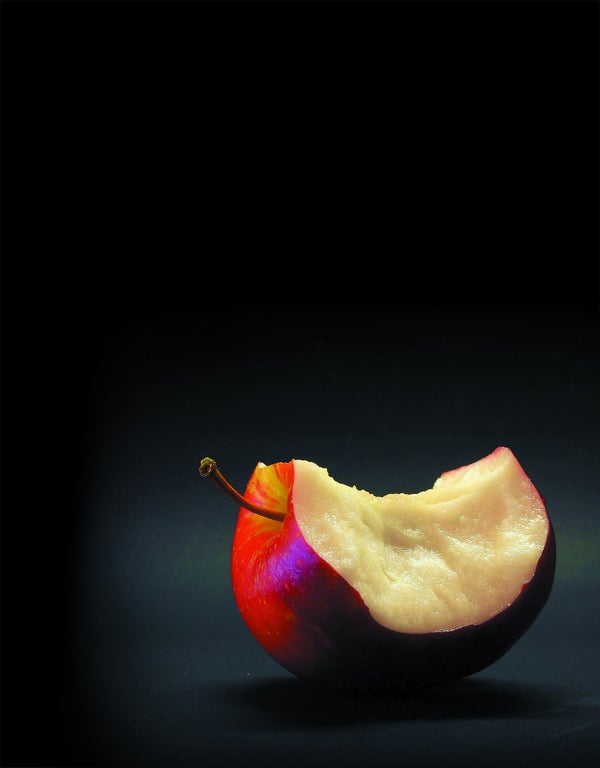
Half eaten red apple against dark background.

Pier Luigi Demontis Getty Images

Join Our Community of Science Lovers!

Edited by Dava Sobel

Nothing's wholly certain. A half

apple lay beside the bed, bites


On supporting science journalism

If you're enjoying this article, consider supporting our award-winning journalism by subscribing. By purchasing a subscription you are helping to ensure the future of impactful stories about the discoveries and ideas shaping our world today.


taken out of it, when his corpse

was found—though no one really tried

to ascertain if it contained

cyanide. After he had seen

Snow White, off and on he would chant

the haggish queen's vile couplet. Did

he dip the apple in the brew

and let the Sleeping Death seep through?

And did it make his dreams come true?

Was he the smartest in the land?

What determines when a machine

must stop? Why is a program bound

to crash? Or a person? Was some

forgetful prince supposed to drop

by, give him the reviving kiss,

and start the soap opera up

again, absent forced estrogen?

Or was his being too at odds

with everything the problem? What

went amiss in this fairy tale?

Was the steeped fruit Newton's or Eve's?

Did he conceive himself beyond

skin and bone? Did he want to be

quantum-mechanically reborn

in the new form of other flesh?

Foresee a castle in the sky

for happy-ever-aftering?

His life of paradox remains

a core enigma. There's no test

to disambiguate the dead

and sort out accident from will,

sheer inevitability

from Russian-roulette randomness,

much less a computer to plumb

the strange-looped onion depths of mind

and crack its tangled cryptograms.

We'd have the truth come absolute,

data bereft of ifs, but it's

adrift, mute, undecidable,

lost in the laptop cenotaph.

Michael L. Johnson's seven books of poetry include Sky Land: A Southwestern Cycle. He has also written books and articles about artificial intelligence, expert systems, New Journalism, education and Western American history.

More by Michael L. Johnson
Scientific American Magazine Vol 324 Issue 6This article was published with the title “Turing and the Apple” in Scientific American Magazine Vol. 324 No. 6 (), p. 24
doi:10.1038/scientificamerican0621-24

It’s Time to Stand Up for Science

If you enjoyed this article, I’d like to ask for your support. Scientific American has served as an advocate for science and industry for 180 years, and right now may be the most critical moment in that two-century history.

I’ve been a Scientific American subscriber since I was 12 years old, and it helped shape the way I look at the world. SciAm always educates and delights me, and inspires a sense of awe for our vast, beautiful universe. I hope it does that for you, too.

If you subscribe to Scientific American, you help ensure that our coverage is centered on meaningful research and discovery; that we have the resources to report on the decisions that threaten labs across the U.S.; and that we support both budding and working scientists at a time when the value of science itself too often goes unrecognized.

In return, you get essential news, captivating podcasts, brilliant infographics, can't-miss newsletters, must-watch videos, challenging games, and the science world's best writing and reporting. You can even gift someone a subscription.

There has never been a more important time for us to stand up and show why science matters. I hope you’ll support us in that mission.

Thank you,

David M. Ewalt, Editor in Chief, Scientific American

Subscribe