Poem: ‘Unison Call’

Science in meter and verse

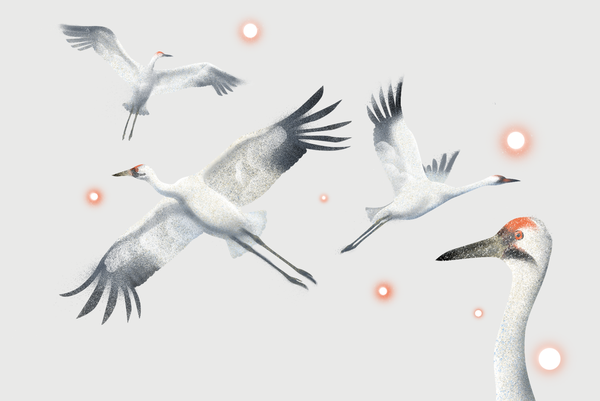
Illustration of multiple cranes flying

Masha Foya

Join Our Community of Science Lovers!

After Gee Whiz, the first whooping crane hatched at the International Crane Foundation in Baraboo, Wis., and the work of crane recovery

So, extirpation:
Wings, glint-white, black-tipped, seven feet wide, river
over glyptodonts and plow horses, marshes and farms,
guns and snowy plumed hats, until power lines
zap elegant necks and we count whoopers
on fingers and toes.

So, we make a little wetland space, in Texas.


On supporting science journalism

If you're enjoying this article, consider supporting our award-winning journalism by subscribing. By purchasing a subscription you are helping to ensure the future of impactful stories about the discoveries and ideas shaping our world today.


So, one bird-loving guy says:
If we stick with it, they’re gonna come through.

A second says:
If it flies, it dies.

So, life.
A zoo-born bird craves
a human mate. Seven years
the first guy dances with her before she lays
a wrinkled buff egg. Around its rare yolk, cells
swell and begin to squirm in the candling machine’s glow.

So, Gee Whiz.
His weird shell dries, requires precise ice water to plump
his tiny sack. He pulses, peeps, hatches hungry. Too
small, he drinks from a tube. Too caged, he pecks
the heck out of chow and the strange cranes who
fill his bowl. When raccoons kill his mama,
he lives. When the second guy shoots
whoopers in Texas, his genes
live.

          When you see your love—
both of you stretch your throats skyward,
bugle your primordial calls
to your kind, rising
nest by incubator, marsh by heart,
ultralight by fledging cinnamon chick.

Elizabeth Kuelbs writes poetry, fiction, and nonfiction for children and adults, often with an emphasis on the natural world and our place within it. Her chapbook Little Victory was a 2022 Independent Press Awards Distinguished Favorite in Social/Political Poetry.

More by Elizabeth Kuelbs
Scientific American Magazine Vol 333 Issue 2This article was published with the title “Unison Call” in Scientific American Magazine Vol. 333 No. 2 (), p. 81
doi:10.1038/scientificamerican092025-3YS3LXPmpB59fEyhMCbSWr

It’s Time to Stand Up for Science

If you enjoyed this article, I’d like to ask for your support. Scientific American has served as an advocate for science and industry for 180 years, and right now may be the most critical moment in that two-century history.

I’ve been a Scientific American subscriber since I was 12 years old, and it helped shape the way I look at the world. SciAm always educates and delights me, and inspires a sense of awe for our vast, beautiful universe. I hope it does that for you, too.

If you subscribe to Scientific American, you help ensure that our coverage is centered on meaningful research and discovery; that we have the resources to report on the decisions that threaten labs across the U.S.; and that we support both budding and working scientists at a time when the value of science itself too often goes unrecognized.

In return, you get essential news, captivating podcasts, brilliant infographics, can't-miss newsletters, must-watch videos, challenging games, and the science world's best writing and reporting. You can even gift someone a subscription.

There has never been a more important time for us to stand up and show why science matters. I hope you’ll support us in that mission.

Thank you,

David M. Ewalt, Editor in Chief, Scientific American

Subscribe