Poems: ‘Water Striders’ and ‘Fallowing’

Science in meter and verse

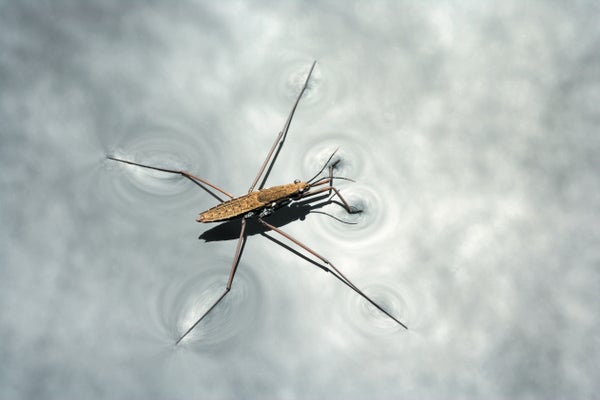
A bug with long legs sitting upon water.

Phil Degginger/Alamy Stock Photo

Join Our Community of Science Lovers!

Edited by Dava Sobel

WATER STRIDERS

Little single scullers striding
on the surface tension of the pond
glide by the turtle-paved bank,
can't sink to the muddy bottom.
Their narrow bodies and thready legs
look like racers' shells and oars.
They criss and cross their skim of water.
I doubt they ponder what's above or under.
The regatta of the striders' lives
looks merry though death will come
by frog or cold or generation's close.
Best not to dive too deep
into that question but stay amazed
at the forces that let them float
and row with greater ease
than the human sculler in a boat.


On supporting science journalism

If you're enjoying this article, consider supporting our award-winning journalism by subscribing. By purchasing a subscription you are helping to ensure the future of impactful stories about the discoveries and ideas shaping our world today.


FALLOWING

I cosseted my weary garden with clover,
practiced patience, saw the vanity of overwork.
The plants fixed nitrogen in the dark
and new riches formed under the green cover.

The land's sabbatical is not unlike human sleep
when the dark dome drops over the aviary of the mind
and the brain consolidates its record of time
through mysterious processes in slow-wave sleep

inscribing in cells what one has skimmed
from the hours: joy and sorrow, anxiety, relief.
That year of fallowing felt brief
but not as brief as the days that spin

or the busy nights that fix in the mind
precious faces, conversations, names,
the memories one wishes to keep safe
though some be rooted in places hard to find.

Lynn Levin teaches writing and literature at Drexel University. Her 2023 debut collection of short stories, House Parties (Spuyten Duyvil), follows her numerous books of poetry, among them The Minor Virtues (2020) and Miss Plastique (2013), both published by Ragged Sky Press.

More by Lynn Levin
Scientific American Magazine Vol 329 Issue 2This article was published with the title “Meter” in Scientific American Magazine Vol. 329 No. 2 (), p. 20
doi:10.1038/scientificamerican0923-20

It’s Time to Stand Up for Science

If you enjoyed this article, I’d like to ask for your support. Scientific American has served as an advocate for science and industry for 180 years, and right now may be the most critical moment in that two-century history.

I’ve been a Scientific American subscriber since I was 12 years old, and it helped shape the way I look at the world. SciAm always educates and delights me, and inspires a sense of awe for our vast, beautiful universe. I hope it does that for you, too.

If you subscribe to Scientific American, you help ensure that our coverage is centered on meaningful research and discovery; that we have the resources to report on the decisions that threaten labs across the U.S.; and that we support both budding and working scientists at a time when the value of science itself too often goes unrecognized.

In return, you get essential news, captivating podcasts, brilliant infographics, can't-miss newsletters, must-watch videos, challenging games, and the science world's best writing and reporting. You can even gift someone a subscription.

There has never been a more important time for us to stand up and show why science matters. I hope you’ll support us in that mission.

Thank you,

David M. Ewalt, Editor in Chief, Scientific American

Subscribe