
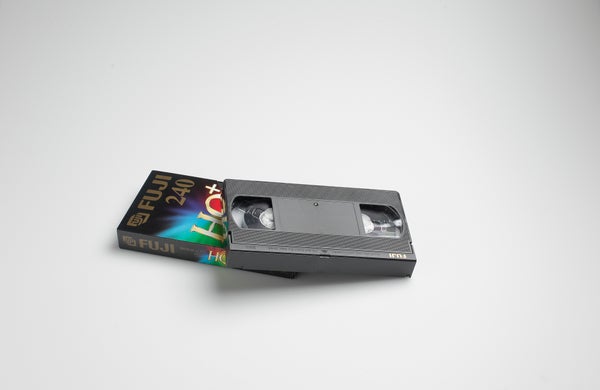
In my Scientific American column this month I mused on the increasing urgency of our need, as a species, to rescue everything we’ve ever recorded on magnetic tape. All those billions of hours of VHS tape, camcorder tape and audio tape are slowly rotting in our basements and attics.
During the camcorder/audiocassette era few of us thought about a future when the tapes would deteriorate and when even the machines capable of playing them would become increasingly rare. Today, we can look back at our younger selves—or our parents’ younger selves—and cluck at our and their naivete.
But aren’t we just as naive now?
On supporting science journalism
If you're enjoying this article, consider supporting our award-winning journalism by subscribing. By purchasing a subscription you are helping to ensure the future of impactful stories about the discoveries and ideas shaping our world today.
Today, we store most of our recorded memories on hard drives. Hard drives will always be around, right?
No, not really. As a standard computer component, they’re only about 30 years old—the blink of an eye on the great human timeline. And an individualhard drive has a limited life span, too—maybe 10 years if you’re lucky.
Meanwhile the format itself is showing its age. Already, many computers use flash storage instead of traditional hard drives, and some—the popular Google Chromebooks—store most of their data online. Bottom line: if you think we’ll still be storing data on spinning mechanical disks 100 years from now, you’re crazy.
So what aboutonline storage? Isn’t that the answer? When we store our audio recordings, photos and videos online, they’re safe, because commercial data centers are massively backed up. They’re easily accessible. And they’re easy to migrate from today’s big hard drives to whatever comes next.
But here again it would be arrogant to assume that what we’re using today will still be the dominant format decades or centuries from now. The Web as a popular, public entity is only about 25 years old. Is it really safe to entrust our most precious recordings to sites like YouTube (11 years old), Vimeo (12 years old), Flickr (12 years old) and Google Photos (one year old)? These aren’t storage formats—they’re companies. Do we really expect them to be around a century from now?
If you consider the short life spans of storage formats (and file formats and operating systems) in the big picture, you’ll quickly realize that there’s no silver-bullet solution. There is no single container for our data that will still be accessible by our grandchildren, let alone theirs. The days of perpetual formats—books, paintings and sculptures that were still intact hundreds of years after their creation—are mostly over.
The only way to preserve our files and recordings is to keep migrating them—every decade or so—to whatever storage system is most promising at the time. It takes effort, it takes remembering and it means that millions of recordings and files won’t survive the generations.
But maybe we can hope that our descendants will at least remember to migrate the important stuff.