
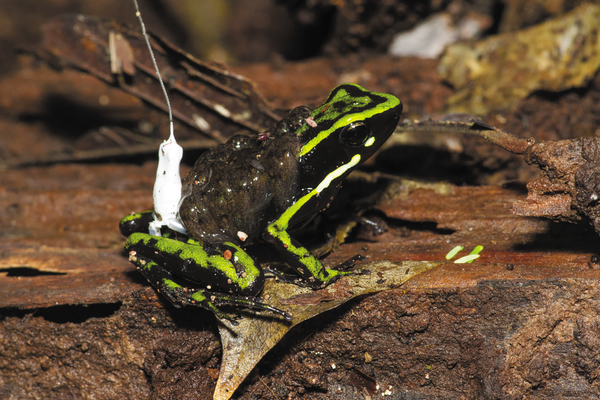
After poison frog tadpoles hatch from their eggs in the leaf litter, they wriggle onto the backs of their patiently waiting fathers, who piggyback them to water. Scientists studying the candy-colored amphibians, sometimes called poison dart frogs, in the Amazon rain forest recently discovered that frog dads often skip close-by ponds in favor of something more distant—a move that expends precious energy. Sometimes they traveled as far as 400 meters, scientists reported in July in Evolutionary Ecology. “It’s actually quite the journey,” says study author and biologist Andrius Pašukonis of Stanford University.
Pašukonis and his colleagues affixed tiny, diaperlike radio transmitters to the bottoms of seven three-striped poison frogs in Peru and 11 dyeing poison frogs in French Guiana. The researchers used radio signals to chart the frogs’ paths on 23 separate journeys, noting each time tadpole-toting fathers passed by water or deposited their young.
Three-striped poison frogs traveled farthest, traversing an average distance of roughly 215 meters—when the nearest available pool was on average only 52 meters away from their home territory. Dyeing dart frogs traveled approximately 39 meters on average, hopping past ponds an average distance of 19 meters away. Two frogs even left the forest’s shelter to deposit their tadpoles in flooded pastures.
On supporting science journalism
If you're enjoying this article, consider supporting our award-winning journalism by subscribing. By purchasing a subscription you are helping to ensure the future of impactful stories about the discoveries and ideas shaping our world today.
Despite the energy cost and higher risk of meeting predators, dropping young tadpoles in faraway pools may offer evolutionary benefits such as decreased risk of inbreeding and less competition for resources, Pašukonis says. But it is difficult to say what exactly motivates the frogs themselves to go farther, notes neurobiologist Sabrina Burmeister of the University of North Carolina at Chapel Hill, who studies poison frog cognition but was not involved in the new research.
The findings could help protect amphibians threatened by habitat loss. “Knowing their ranges, and the types of habitats they utilize and why, would be very important for any type of conservation effort,” Burmeister says.