
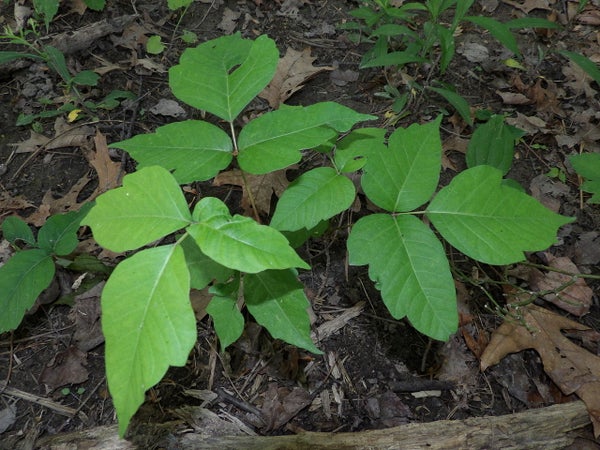

A casual brush with poison ivy can cause agonizing itching for an estimated 10 to 50 million Americans every year. But exactly how the plant inflicts such misery is still somewhat of a mystery. By exposing mice to poison ivy’s oily allergen urushiol, Sven-Eric Jordt of Duke University and colleagues have now pinpointed a molecular pathway that helps transmit an itch signal through nerve cells.
Antihistamines and corticosteroids are commonly prescribed to people with a poison ivy rash. But “the antihistamines just don’t work,” Jordt says, and although steroids help with inflammation, they’re ineffective against itch. “So from all perspectives, it is necessary to revisit the mechanisms and identify a more efficient treatment,” he adds.
The researchers looked for genes that were transcribed at higher levels in mice whose skin was brushed with urushiol compounds compared with nonexposed mice. (Proc. Natl. Acad. Sci. USA2016, DOI: 10.1073/pnas.1606608113). Unsurprisingly, several genes involved in inflammation were upregulated in the urushiol-exposed mice. But the team focused on one particular gene that codes for the protein interleukin-33, previously associated with itchy skin conditions such as psoriasis. When the researchers gave itchy, urushiol-exposed mice antibodies against IL-33, the mice slowed their scratching considerably. Similarly, an antibody against IL-33’s receptor, ST2, which is located on sensory neurons that connect to the animals’ skin, also reduced scratching.
On supporting science journalism
If you're enjoying this article, consider supporting our award-winning journalism by subscribing. By purchasing a subscription you are helping to ensure the future of impactful stories about the discoveries and ideas shaping our world today.
Ethan A. Lerner, a dermatologist studying itch at Massachusetts General Hospital, calls the study “both surprising and not surprising,” because researchers suspected a link such as this one existed even though they didn’t know the specifics. “The immune system and the nervous system are talking to each other all the time,” he says. Although the molecular pathway for itch is complicated, he adds, these systems will likely share features important for future drug design.
Unrelated to the Duke group’s work, antibodies against IL-33 and ST2 are the stars of two current clinical trials. AnaptysBio hopes to treat atopic dermatitis, peanut allergies, and asthma after finishing Phase I safety trials, and Genentech’s Phase II trial focuses on asthma and chronic obstructive pulmonary disorder. Next, Jordt’s team hopes to work with clinicians to see if they can detect IL-33 in humans with poison ivy.
This article is reproduced with permission from Chemical & Engineering News (© American Chemical Society). The article was first published on November 9, 2016.