
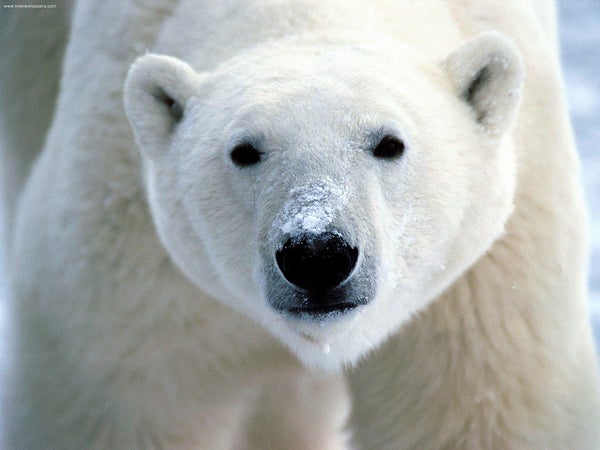
Nothing pulls at the heartstrings quite like a starving polar bear.
A wrenching video published on National Geographic's website made that clear after going viral in December. Shot by documentary filmmaker Paul Nicklen, the clip follows an emaciated bear struggling its way across the barren landscape (Climatewire, Dec. 15, 2017).
While scientists were quick to caution that the causes of the animal's condition remain unknown—disease, injury or any number of other factors could potentially have spelled its demise—experts are worried that starving polar bears may soon become a more common sight as the sea ice they rely on for hunting grounds continues to melt away.
On supporting science journalism
If you're enjoying this article, consider supporting our award-winning journalism by subscribing. By purchasing a subscription you are helping to ensure the future of impactful stories about the discoveries and ideas shaping our world today.
New research published yesterday in Science adds fuel to those concerns. The study suggests that polar bears need more energy to survive than previously thought—and they might not be catching enough prey to meet those demands.
By tracking nine female bears in the Beaufort Sea region off the coast of Alaska last April, the researchers found that the bears' metabolic rates—that is, the amount of energy their bodies require to function—were about 60 percent higher than scientists had previously assumed. Over the course of the study, five of the nine bears lost body mass, meaning they weren't taking in enough food to meet those energy demands. In fact, four of them lost at least 10 percent of their weight in the span of about 10 days.
The study presents "kind of a snapshot of what the bears are doing during this one time of year, in the month of April, when we're able to do our field work," said lead study author Anthony Pagano, a research wildlife biologist and polar bear expert with the U.S. Geological Survey. "The next step is to use this information to really start to quantify how changes in movement patterns might be affecting the energy demands of these bears."
Polar bears put on most of their weight by feasting on blubbery, energy-rich seals. The best way to catch one is to perch at the edge of the sea ice covering the Arctic Ocean and wait for a seal to surface for air. Polar bears pack on much of their body fat for the year during the spring and early summer, when seals are birthing and raising young pups and are at their most vulnerable.
But scientists worry that ongoing climate-driven declines in Arctic sea ice, particularly during the warm months of the year, may be affecting the bears' hunting success. As the ice retreats farther and farther north, the bears may be forced to walk or even swim long distances just to reach a suitable hunting ground. Bears that make it that far must expend large quantities of energy in the process, which they may not be able to entirely replace with the seals they catch. Other bears may turn to foraging and scavenging instead, but the food they come across may not be able to meet their high daily energy demands.
Until now, there's been little information available on polar bears' daily energy demands and how they're affected by their day-to-day movements. But the new study helps to validate these concerns.
The researchers equipped the animals with special radio collars to track their movements and took blood samples to monitor their metabolic rates and energy demands. Five of the bears were successful in hunting seals during the study period, and four were able to put on some weight, they found. The four bears that lost significant amounts of weight had been unable to catch any seals. This means that any food they were able to scavenge on land during this time was simply not enough.
The research could help explain some of the population declines scientists have observed in the Beaufort Sea region over the last decade or so. Another study from USGS, first published in 2015, found that bears in the southern Beaufort Sea suffered about a 40 percent decline between 2001 and 2010.
But more tracking and monitoring will be necessary to fully understand what's happening to the bears. For now, the study demonstrates that bears' energy demands are likely higher than expected—meaning they require more food to survive than previously thought—and that failure to catch seals can result in rapid, significant weight loss. What's needed next is longer-term research on how diminishing sea ice is affecting bear behavior and energy demands.
"This is kind of the initial step, and the next step will be to see how energy expenditure is changing seasonally and how changing ice conditions are ultimately impacting the energy expenditure of these bears," Pagano said.
Reprinted from Climatewire with permission from E&E News. E&E provides daily coverage of essential energy and environmental news at www.eenews.net.