
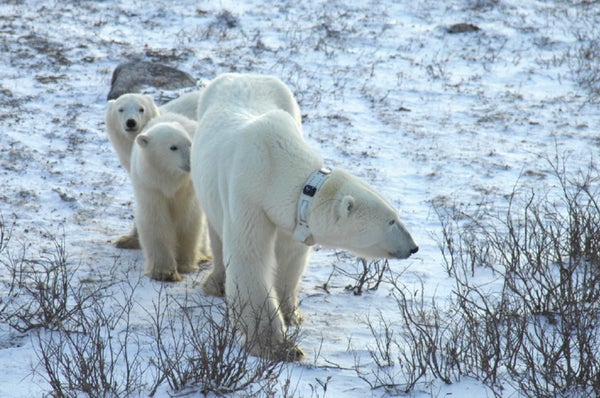
Just because a scientist puts a GPS tracking collar on a wild polar bear does not mean the animal will obligingly keep it on. In fact, these humongous neckbands are purposefully girthy so that if one becomes irritating, a bear can remove it. But scientists have now found a way to use signals from the discarded devices.
“These dropped collars potentially would have been considered garbage data,” says Natasha Klappstein, a polar bear researcher at the University of Alberta. She and her collaborators (including researchers at the University of British Columbia and Environment and Climate Change Canada) instead used measurements from such collars, left on sea ice in Canada's Hudson Bay, to track the ice itself.
For their study, published in June in The Cryosphere, the researchers identified 20 collars that transmitted movement data consistent with ice drift rather than polar bear motion between 2005 and 2015. The resulting records of how melting ice typically drifts in Hudson Bay are unique; there are no easily accessible on-the-ground sensors, and satellite observations often cannot accurately capture the motion of small ice sheets.
On supporting science journalism
If you're enjoying this article, consider supporting our award-winning journalism by subscribing. By purchasing a subscription you are helping to ensure the future of impactful stories about the discoveries and ideas shaping our world today.
The team compared the discarded collars' movements to widely used ice-drift modeling data from the U.S. National Snow and Ice Data Center (NSIDC). Collar data indicated that the NSIDC model underestimates the speed at which ice moves around in Hudson Bay—as well as the overall extent of drift. Over the course of several months the model could diverge from an ice sheet's location by a few hundred kilometers, the researchers say.
This means the bears may be working harder, when moving against the direction of the ice, than scientists had assumed: “Since we're underestimating the speed of drift, we're likely underestimating the energetic [effort] of polar bears,” says University of British Columbia's Ron Togunov, lead author of the study.
The research reveals timely insight into how highly mobile ice moves. As melting increases in coming years, such ice will likely become more common farther north, in the central Arctic, says Andy Mahoney, a geophysicist at the University of Alaska, Fairbanks, who was not involved in the study. Scientists had known NSIDC data could underestimate drift speeds, Mahoney says, but “any time we can find a data gap and plug it is a good thing.”
Plus, such data could improve predictions about how oil spills or other pollutants may spread in seas littered with drifting ice, says Walt Meier, a senior NSIDC research scientist, who was also not involved in the study. The findings may even influence future NSIDC models: “It's a really nice data set,” Meier says. “And certainly one we'll take under consideration.”