
In a disappointing setback for the global effort to eradicate polio, two children have been paralyzed by the virus in Nigeria, which had gone two years without reporting a case.
Prior to Thursday’s announcement by the World Health Organization, it had been thought that polioviruses were only circulating in two countries in the world, Afghanistan and Pakistan.
The development is one the community of people fighting polio had been dreading.
On supporting science journalism
If you're enjoying this article, consider supporting our award-winning journalism by subscribing. By purchasing a subscription you are helping to ensure the future of impactful stories about the discoveries and ideas shaping our world today.
“I think of all of those things that have kept people in polio eradication up at night, this is the one that we have been most fearful of,” said Dr. Stephen Cochi, a senior polio program scientist at the Centers for Disease Control and Prevention.
Now the fear is about how many cases there will be — and over how large a distance — before the outbreak can be brought under control.
“We’re anticipating that there may well be more than two cases,” Cochi admitted. “We have to be prepared for additional cases and perhaps the possibility that there’s a larger geographic extent to this outbreak.”
The cases were found in Borno, a state in northeastern Nigeria. The Islamic extremist group Boko Haram is active in Borno, and the instability in the region has meant as many as a half-million children have been out of the reach of polio vaccination efforts for the past two years, Cochi said.
Often in conflict zones the polio program has been able to negotiate so-called days of tranquility, where combatants put down their arms to allow for the vaccination of children. That has not been possible in Borno.
“Boko Haram is so demonstrably anti-Western in every way, shape, and form, whether it’s education or health care, that there’s no negotiating days of tranquility with Boko Haram,’’ Cochi said.
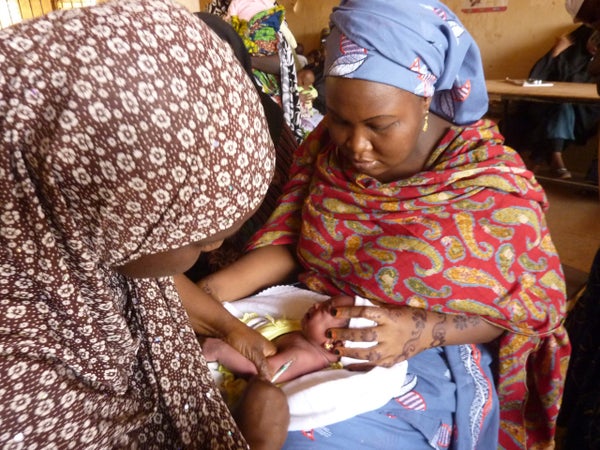
Planning is already underway to mount emergency vaccination efforts in as much of Borno as can be reached, as well as in at least three neighboring states in Nigeria. As many as 1 million children will be targeted for vaccination in the next few days, Cochi said.
But the response will need to be a regional one, he noted, and may involve the vaccination of as many as 5 million children.
Borno sits in the northeastern corner of Nigeria, bordering Chad, Niger, and Cameroon. The political volatility is not restricted to Nigeria and there has been displacement of people within the region.
Analysis of the genetic sequences of viruses recovered from the children shows that they are most closely related to polioviruses that were circulating in Borno in 2011. That means transmission in Nigeria — or surrounding countries — never fully stopped, but was not detected by surveillance efforts.
“It’s a blow,” Sona Bari, a spokeswoman for the WHO’s polio program, told STAT.
“It’s the first time in history that a country has stopped transmission and then found indigenous virus again.”
Only a small fraction of polio infections lead to paralysis, which means viruses can circulate without being easily detected. It’s estimated that for every one case of paralytic polio, there are 200 silent infections.
As has so often been the case with the polio eradication effort, the setback comes at a time when prospects for eradication were looking extremely promising.
In 2015 Nigeria was dropped from the list of polio-endemic countries, having seemingly stopped transmission of the virus for a year. That milestone meant only two countries — Afghanistan and Pakistan — were endemic polio areas.
To date, this year those two countries have reported only 19 cases, the lowest global tally ever. Optimism has been high that transmission in those remaining countries might be arrested in 2017.
“With good execution in Pakistan-Afghanistan, which we think we’re getting, with a bit of luck, the last wild-type case will be some time in 2017, and then we start a three-year clock for eradication,” philanthropist Bill Gates told STAT in an interview earlier this summer.
The Bill and Melinda Gates Foundation is one of the partners in the Global Polio Eradication Initiative. The others are the WHO, UNICEF, the Centers for Disease Control and Prevention, and the service club Rotary International.
But even before the Nigerian cases came to light, Gates knew to hedge his bets.
“But boy, polio is a hard disease. It has characteristics that make it way harder to eradicate than smallpox,” he said in the interview with STAT.
Smallpox is the only human disease that has ever been eradicated.
In a statement Thursday, the Gates Foundation said it was deeply concerned by the news, but not discouraged.
“The fight to end polio continues, often under some of the world’s most difficult and dangerous circumstances, and we will not give up until every last child is protected.”
Republished with permission from STAT. This article originally appeared on August 11, 2016