
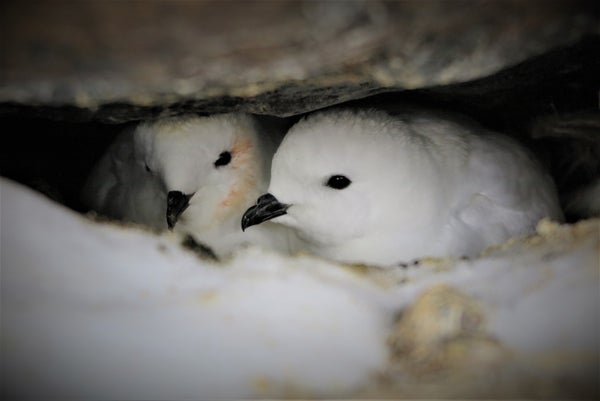
Erin McClymont’s laboratory has six kitchen freezers, each alarmed for self-preservation: if the power goes out or an appliance breaks down, she needs to act quickly to prevent the nauseating smell of old fish from seeping out. The source of that stench is solidified blocks of 50,000-year-old regurgitated stomach oil from Antarctic Snow Petrels, hunks of which line each freezer’s shelves.
“One of my colleagues who did some of the original sampling [has] been on fieldwork where they’ve had to dump their coats at the end because they can’t get the smell out,” says McClymont, a paleoclimatologist at Durham University in England. The blocks “are revolting,” she adds.
The solidified oil is an indirect record, or proxy, of the past that scientists rely on “because we don’t have a time machine,” says Tyler Karp, a paleoecologist at the University of Chicago. Researchers trying to understand Earth’s climate and ecosystems need to trace rainfall, ice coverage, fire and other factors over thousands or millions of years—far longer than human records go back. But the most common proxies, including tree rings, pollen and ice cores containing pockets of ancient air, have already been well studied. To learn something new, researchers have to get creative.
On supporting science journalism
If you're enjoying this article, consider supporting our award-winning journalism by subscribing. By purchasing a subscription you are helping to ensure the future of impactful stories about the discoveries and ideas shaping our world today.
So scientists look for clever ways to study obscure features of the past such as changes in the Antarctic environment over tens of thousands of years, the focus of McClymont’s research. Sea ice makes it particularly hard to drill samples from the Antarctic seafloor, so she and her collaborators found a more obscure polar record to explore: seabird stomach oil. Snow Petrels spit out the oil in front of their nests, primarily to ward off predators with its smell and stickiness. That vomit accretes in layers across avian generations, trapping 50,000 years’ worth of data about the birds’ diet and the sea ice environment.

Solidified Snow Petrel stomach oil.
Dominic Hodgson/British Antarctic Survey
Seabird oil is a good proxy because it’s composed of waxes and fats, which degrade more slowly than proteins and carbohydrates do. Researchers can radiocarbon-date and biopsy chunks to determine the source of their carbon and nitrogen—a process that requires first using a large saw to cut through what feels like “a mild cheddar: slightly soft and squishy,” McClymont says. As sea ice shrinks or expands, the surface ocean warms or cools, respectively. That in turn affects how nutrients cycle and where different species can live, which shows up in the birds’ regurgitations.
Such methods have revealed that as Antarctic ice sheets expanded during the last glacial maximum, sea ice got pushed farther offshore, forcing krill to move out of the petrels’ feeding ranges. The finding suggests that Snow Petrels are capable of temporarily adapting to different food sources and might do so again during future climate changes.

Sampling Snow Petrel stomach oil.
Zhongxuan Li/Durham University
Tripti Bhattacharya, a paleoclimatologist at Syracuse University, also takes advantage of waxy substances—though much less smelly ones. She puts fossilized, freeze-dried sediments through a “glorified espresso machine” to extract the hydrophobic outer coating of ancient leaves, called leaf wax. As plants use rainwater to grow, their leaves pick up the rain’s characteristic ratio of hydrogen isotopes—atoms with the same number of protons and different numbers of neutrons. Hydrogen isotope ratios can be traced back to reveal how much and when water fell onto a plant.
Bhattacharya found that the last time carbon dioxide levels in the atmosphere went above 400 parts per million, as present-day levels are, southern California had rainy summers; today it has rainy winters. The finding helps to explain the hot, humid environment that made California suitable for tropical animals such as crocodiles three million years ago. Climate change probably won’t bring crocs back to the West Coast, but ecologists can use data on ancient weather to forecast the kinds of species that might thrive in a similar future. “Proxy data might seem like this obscure scientific thing, but they actually directly help our efforts to manage climate risk,” Bhattacharya says.
Rainfall inspires even stranger proxies than leaf sediments: when ostriches eat plants that grew in rainy conditions, a signature isotope ratio of nitrogen in the soil transfers into their body and, ultimately, their eggs.
Princeton University geochemistry Ph.D. student Mingzhe (Damon) Dai collaborates with archaeologists to obtain samples of ostriches’ eggs buried in early human settlements where the inhabitants ate the birds and used the eggshells as water containers. The eggs’ nitrogen isotope ratios can help him reconstruct the rainfall experienced by early humans across Africa and Asia.
Dai’s initial results have revealed that rainfall was low in South Africa during the last glacial maximum and increased as the planet warmed. Dai says changes in human culture and behavior occurred at the same time as these climate shifts, suggesting the shifts could have been an important driver of such alterations to the way people lived.
Although scientists can use conventional records such as sediment and seafloor cores to reconstruct the global climate during civilization’s early days, “the resolution is too [coarse], so it’s not that fun for us to discuss something that happened on the local scale, which is relevant to the human story,” Dai explains. Coincidentally, ostriches and early humans moved within roughly the same area in their lifetimes: 85 square kilometers. If an ostrich egg reveals rainy conditions, it means that precipitation most likely also fell on the individual human settlement where it was found—and maybe the inhabitants changed their behavior accordingly.
Karp likes the way these unusual records enable him to “use the past as an experiment.” He studies primarily chemical remnants of burned plants, called polycyclic aromatic hydrocarbons (PAHs), to trace ancient fires. He also looks at chemicals called stanols, which are found in herbivore dung and help to reveal when animals such as elephants, zebras, hippopotamuses and impalas roamed the land. As ecologists contemplate reintroducing fire or animals to landscapes that human activity has removed them from, Karp says it’s helpful to check such strange records to see how environments responded in the past, like a natural field trial.
Ultimately, every proxy has its limitations; some, such as PAHs, can come from multiple sources, so it’s hard to ensure that you’re tracking the right phenomenon. Others, such as seabird oil, may be older than radiocarbon dating can divulge. And in general, you need several detailed experimental steps to link such an unusual record to the pattern you’re trying to study, Bhattacharya says, which adds uncertainty and error at each step.
Yet for many researchers, these ancient remnants are often the only clues available. “I don’t think that when I first started studying science, I would have expected that I’d be studying poop,” Karp says. But “the more different tools you can use to look at the same question from more angles, the better and better we get about having a good consensus on what actually happened.”