
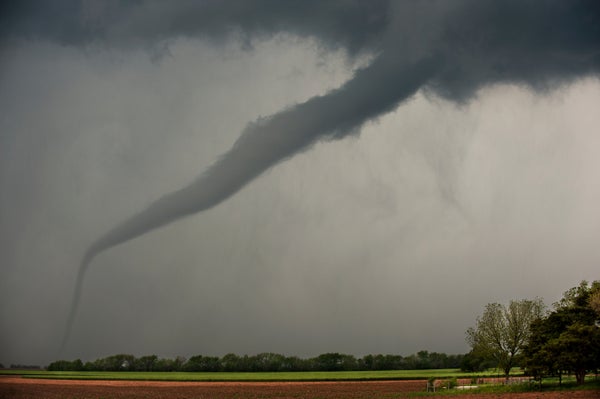
Among natural disasters, tornadoes are notoriously difficult to predict. They require a complex set of conditions in order to form, some of which scientists still don't fully understand, and forecasting is rarely accurate more than a week or two in advance.
That makes it even harder to parse out the potential influence of global warming on tornado season.
But scientists have begun to uncover some intriguing links between tornado outbreaks in the United States and large-scale climate patterns in other parts of the world. Shifting ocean temperatures, thousands of miles away, may have an influence on twisters in some of the nation's most tornado-prone states.
On supporting science journalism
If you're enjoying this article, consider supporting our award-winning journalism by subscribing. By purchasing a subscription you are helping to ensure the future of impactful stories about the discoveries and ideas shaping our world today.
Research published this week in Science Advances points to a link between sea surface temperatures in the Pacific Ocean and the Gulf of Mexico and April tornadoes in the southern Great Plains — part of "Tornado Alley." Active years with high numbers of tornadoes seem to be associated with times of cooler temperatures in parts of the central and eastern Pacific and warmer temperatures in parts of the northern Pacific and the Gulf of Mexico.
These patterns help to influence a large-scale atmospheric circulation system that favors the formation of supercell thunderstorms and sets up conditions for tornadoes to form.
The effect appears to be strong in April, but is much less certain in May, according to the study. As a result, researchers suggest that tornado forecasting may be easier during some parts of the spring tornado season than others.
These aren't exactly new conclusions. Multiple studies have already drawn connections between sea surface temperatures in the Pacific and the Gulf and U.S. tornado activity, said Victor Gensini, an expert on extreme weather and climate at Northern Illinois University.
The El Niño-La Niña cycle, for instance — a natural climate cycle characterized by temporary shifts in Pacific Ocean temperatures — is known to have an effect on tornado season. El Niño years tend to be associated with lower spring tornado activity, while La Niña years favor more tornadoes.
"In that regard, it's not extremely novel," Gensini told E&E News.
But the research does underscore the complexity of tornado forecasting from one year to the next, and the even greater complexity of accounting for the influence of climate change in the long term.
Some research has suggested that extreme El Niño events may occur more frequently in a warmer world. And the authors of the new study suggested that the patterns of warming currently occurring in the Pacific may seem to favor less tornado activity in the earlier part of the season.
But there are a wide variety of other factors to consider. Warming in the Gulf of Mexico, for instance, is generally likely to make conditions more favorable for the kinds of storms that tend to produce tornadoes, said meteorologist John Allen of Central Michigan University.
In general, climate change is expected to drive an increase in severe thunderstorms across much of the United States, which could theoretically increase tornado activity. But then again, the formation of a thunderstorm doesn't guarantee that tornadoes will come along with it.
More questions than answers
For the time being, it's fairly difficult to say with confidence whether tornado activity has experienced any meaningful changes.
In the first place, tornadoes are relatively rare events compared with other types of weather phenomena, Allen pointed out. On average, only about 1,200 or so occur in the United States each year.
Additionally, tornadoes tend to be sudden, short-lived events, meaning they were not always well-documented in the past, Gensini noted. These days, cellphones and social media make it much easier to record tornado activity in the moment. That makes it difficult to compare more recent records with older ones — it may appear that tornado activity has been steadily increasing, when in fact people are just reporting it more frequently than they used to.
And it's also difficult to study the effects of global warming on tornadoes than it is with other types of weather events, he added. Large-scale climate models generally can't produce fine-scale, spontaneous events like tornadoes.
Still, a few patterns do seem to be emerging. While overall tornado numbers across the United States seem to be holding fairly constant, there appears to be a shift toward more activity in the Midwest and the Southeast and less across the Great Plains, according to a study Gensini published last year with co-author Harold Brooks.
Other studies have suggested that when tornadoes occur in clusters, the size of those groups may be growing larger. And according to Gensini, there also seems to be more variability in tornado seasons from one year to the next, or an increase in the difference in tornado activity year over year.
That said, the exact links to climate change in these patterns are still unclear.
For now, scientists can say that certain types of weather patterns related to tornado formation, like severe thunderstorms, are subject to the influence of climate change.
"You might be able to say with confidence that the United States as a whole is moving into a weather regime that's more favorable or less favorable for tornado activity," Gensini said.
But there are so many variables that can affect these events that making predictions about future trends is still difficult to do with any certainty.
Studies like this week's paper may imply the possibility of changes in the variability of tornado activity from one year to the next, with shifts in sea surface temperatures and patterns like El Niño.
But as far as concrete climate-related projections, Allen said, "'Stay tuned' is the answer."
Reprinted from Climatewire with permission from E&E News. E&E provides daily coverage of essential energy and environmental news atwww.eenews.net.