
By William Mallard
An earthquake with a preliminary magnitude of 7.3 hit northern Japan on Tuesday, the Japan Meteorological Agency said, issuing tsunami advisories for much of the nation's northern Pacific coast.
The epicenter of the earthquake, which was felt in Tokyo, was off the coast of Fukushima prefecture at a depth of about 10 km (6 miles), the agency said.
On supporting science journalism
If you're enjoying this article, consider supporting our award-winning journalism by subscribing. By purchasing a subscription you are helping to ensure the future of impactful stories about the discoveries and ideas shaping our world today.
There were no immediate reports of damage or injury, which struck at 5:59 a.m. (3.59 p.m. ET).
Tokyo Electric Power Co was checking its nuclear plants in Fukushima for damage, public broadcaster NHK said. The utility could not immediately be reached by Reuters.
Tohoku Electric Power Co said there was no damage to its Onagawa nuclear plant.
Television footage showed ships moving out to sea from Fukushima harbors, as the meteorological agency warned of a tsunami of 3 meters (10 feet) for Fukushima, where Tepco's Daiichi nuclear plant was devastated in a March 2011 quake and tsunami.
Earthquakes are common in Japan, one of the world's most seismically active areas. Japan accounts for about 20 percent of the world's earthquakes of magnitude 6 or greater.
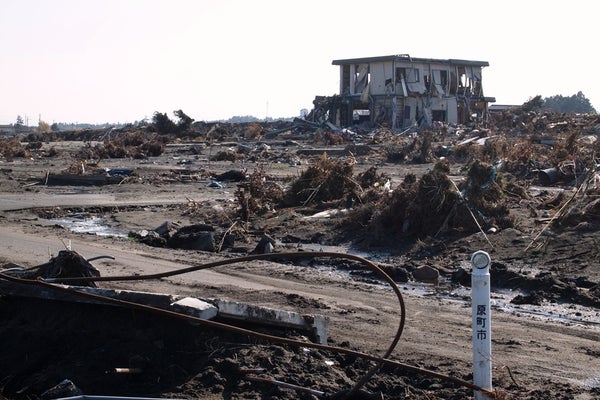
The March 11, 2011, quake was magnitude 9, the strongest quake in Japan on record. The massive tsunami it triggered caused world's worst nuclear crisis since Chernobyl a quarter of a century earlier.
The U.S. Geological Survey initially put Tuesday's quake at a magnitude of 7.3 but down graded it to 6.9.
All nuclear plants on the coast threatened by the tsunami are shutdown in the wake of the Fukushima disaster. Only two reactors are operating in Japan, both in the southwest of the country. Even when in shutdown nuclear plants need cooling systems operating to keep spent fuel cool.