
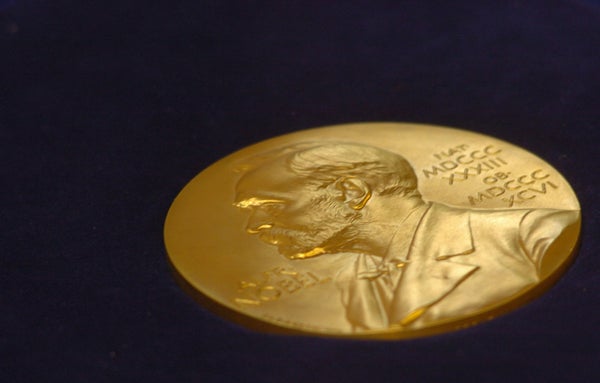
In just over a week the world will find out who has won the 109th chemistry Nobel prize. As excitement builds once more, analysts and online commentators are making their predictions on who they think has a chance of securing science’s top gong, with suggestions ranging from Crispr to heterogeneous catalysis and perennial also-ran the lithium–ion battery.
Clarivate Analytics, which maintains the publication indexing platform Web of Science, has released their citation laureates, hailing discoveries in the area of C–H functionalisation, heterogeneous catalysis and perovskites as Nobel-worthy. Since 2002, the citation laureates list—which, until last year, was published by Thomson Reuters—attempts to predict winners based on analyses of citation data. Thomson Reuters successfully predicted that one of last year’s laureates, Fraser Stoddart, would get the chemistry Nobel.
On supporting science journalism
If you're enjoying this article, consider supporting our award-winning journalism by subscribing. By purchasing a subscription you are helping to ensure the future of impactful stories about the discoveries and ideas shaping our world today.
Clarivate has put forward US chemists John Bercaw and Robert Bergman alongside Russian researcher Georgiy Shul’pin for the chemistry prize for critical contributions to C–H functionalisation, a widely used type of reaction that replaces carbon–hydrogen with carbon–carbon or other bonds.
Chemical engineer Jens Nørskov from Stanford University, US, is another possible for the chemistry prize for his fundamental work on heterogeneous catalysis, which has led to advances in ammonia synthesis and fuel cells. Clarivate also put forward Tsutomu Miyasaka from Japan, Nam-Gyu Park from South Korea and Henry Snaith from the UK, who they suggest might be honoured for the discovery of perovskites and their use in solar cells.
A trio consisting of chemical physicist Phaedon Avouris and physicist Paul McEuen, both from the US, as well as Dutch physicist Cornelis Dekker has been put forward as potential winners of the physics Nobel prize for their work on carbon nanostructures. Their research concerning carbon nanotubes, graphene and nanoribbons, and their application in electronics are, however, topics that might also be regarded as worthy of a chemistry prize.
Samuel Lord, author of the Everyday scientist blog and researcher at the University of California, US, believes the chemistry Nobel might go to Jennifer Doudna, Emmanuelle Charpentier and Feng Zhang for their work on gene-editing technology Crispr. Both DNA researcher Crisanto Gutierrez and molecular biologist Alexis Verger agree, posting on Twitter that they think the Crispr developers have a shot at the chemistry prize.
The honour society Sigma Xi, who has been running a Nobel prize prediction contest on their blog, is currently asking readers to choose between their two chemistry finalist duos: lithium–ion battery inventors Stanley Whittingham and John Goodenough, or bioinorganic chemistry pioneers Harry Gray and Stephen Lippard. Lord had also considered Goodenough as a Nobel contender but thinks his recently developed ultra-efficient battery, which attracted criticism from other scientists, might be too controversial for the Nobel committee.
The chemistry Nobel prize will be revealed on 4 October, two days after the prize for physiology or medicine, and a day after the physics prize.
This article is reproduced with permission from Chemistry World. The article was first published on September 25, 2017.