
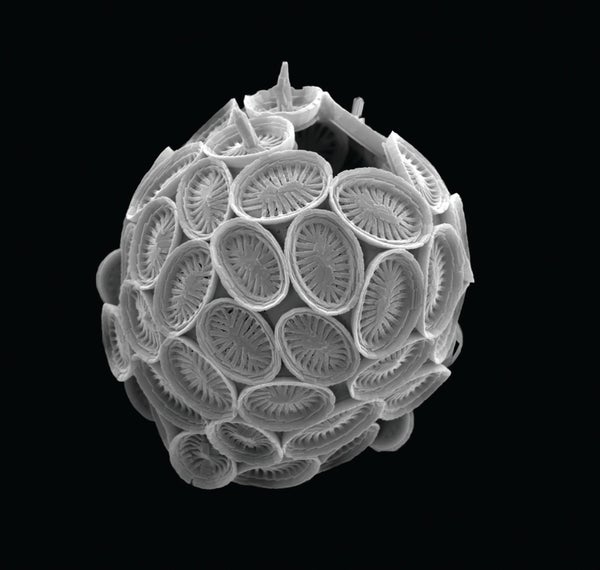
An asteroid strike 66 million years ago not only devastated the dinosaurs but almost reset life in the oceans back to a primitive soup of simple microorganisms. What prevented ocean ecosystems from totally collapsing, scientists hypothesize, may have been shell-covered algae that could feed on other organisms but maintained the ability to photosynthesize. This skill would preserve the foundation of the marine realm's complex food webs through a long dark spell.
The predatory plankton belonged to a family of armored, algaelike organisms called coccolithophores, or coccoliths. They have been around for about 200 million years, and many forms still bob along as ocean plankton today. But their survival was especially significant in the wake of the mass extinction at the end of the Cretaceous period, when debris from the asteroid's impact and wildfire ash blotted out the sun for two years. Life experienced a prolonged “impact winter” when photosynthesis all but ceased.
“The food webs in the ocean have photosynthesis as their foundation, just like the land, but in the ocean the photosynthesis is carried out by microscopic bacteria and algae,” says University of Southampton paleontologist Samantha Gibbs, lead author of a new study in Science Advances. Coccoliths were among these energy converters in the Cretaceous, and about 90 percent of coccolith species went extinct after impact.
On supporting science journalism
If you're enjoying this article, consider supporting our award-winning journalism by subscribing. By purchasing a subscription you are helping to ensure the future of impactful stories about the discoveries and ideas shaping our world today.
Lacking light for their energy needs, Gibbs says, “the handful of survivor species were able to turn to food capture and ingestion.” Small holes in coccolith fossils indicate that the survivors possessed whiplike flagella that let them move and stalk other organisms. The researchers tracked hunter algae's prevalence in the fossil record and modeled the organisms' evolution to show how they could have survived and adapted to the sun's disappearance—and then its return, when they proliferated again.
Experts have long wondered how photosynthesis-using organisms such as coccoliths endured without sunlight. “This is a really exciting finding that goes a long way to explaining an apparent paradox in the extinction,” says University of Texas at Austin paleontologist Christopher Lowery, who was not involved in the study.
The model may explain changes in other organisms as well. Small creatures called foraminifera, or forams, also took a hit from the impact but persisted. They were armored, too, and those that survived evolved spines. The spines would have worked together with miniature tentacles to help forams grab larger prey, Lowery says, bolstering the idea that other single-celled organisms also adapted their feeding style.
Eventually coccolith survivors picked up photosynthesis again, revitalizing the ocean's food webs when light returned. Tiny, hungry algae helped to save the seas.