
In late 2012 NASA’s Hubble Space Telescope spotted what appeared to be plumes of water vapor spewing from the frozen surface of Jupiter’s moon Europa. Another observation last year provided more evidence this was not a fluke. It is likely that below that distant world’s ice is an ocean larger than all of Earth’s combined. This created a frenzy in the astrobiological community—brimming with all that water, could Europa also have the necessary ingredients for life?
Now NASA is gearing up for a robotic mission to this mysterious moon. The Europa Clipper is slated to launch in the early 2020s, equipped with instruments for imaging, sampling and analyzing just what lies within the distant world. NASA scientists have plenty of experience in relaying information from faraway probes back to Earth—but the actual tools for measuring the stuff of life in situ are less familiar, so scientists have turned to our planet’s own deep ocean for answers. “Technologically, we share mutual goals and approaches with deep-ocean scientists,” says Mary Voytek, director of NASA’s Astrobiology Program. “We look to understanding what's going on here on Earth in order for us to understand what’s going on beyond Earth.”
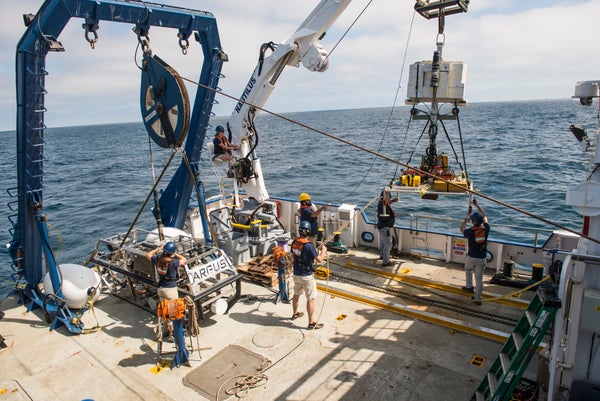
NASA tasked Peter Girguis, a marine biologist at Harvard University, and his colleagues at the Woods Hole Oceanographic Institution with developing the ultimate deep-ocean observatory, which they deployed for the first time this August. They want technology that can both elucidate the chemical processes that support life in Earth’s deep ocean as well as detect the ingredients for life on other ocean worlds.
On supporting science journalism
If you're enjoying this article, consider supporting our award-winning journalism by subscribing. By purchasing a subscription you are helping to ensure the future of impactful stories about the discoveries and ideas shaping our world today.
Their observatory—a deep-ocean lander appropriately named the ABISS, for Autonomous Biogeochemical Instrument for In Situ Studies—is a portable seafloor platform capable of powering and supporting a combination of devices for taking measurements in the deep ocean. It is controlled wirelessly from the surface using an optical modem. This system also sends and receives data and imagery in real time with flashes of laser light, transmitted in sequences like a computerized Morse code. Developed at Woods Hole, this new modem technology is a game changer for deep-ocean research because it allows scientists to easily manipulate and control instruments without a physical cable connection—something that was only possible previously using sonar, which is too slow for this kind of work. Now, scientists on a nearby ship can simply use optical signals transmitted through open water to control and receive readout from an observatory’s instruments. This brings NASA one step closer to conducting scientific studies in Europa’s ocean, where wireless communication through a layer of ice hundreds of kilometers thick may be the only option.
In this video, watch as scientists and engineers from Harvard and Woods Hole deploy the ABISS and test its optical modem for the first time off the coast near Los Angeles from the ship E/V Nautilus. This exploration vessel is operated by the Ocean Exploration Trust, an organization founded by oceanographer Robert Ballard. For the next two years, Girguis and his team plan to test and control various instruments on the ABISS wirelessly from the ship, bringing the technology one step closer to a journey to Europa.