
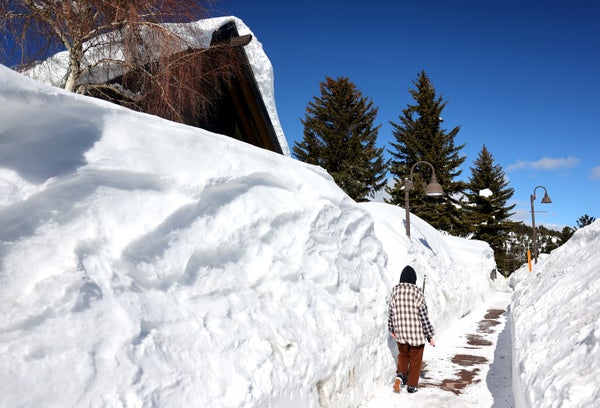
CLIMATEWIRE | California's snowpack neared record levels Friday, offering good news for the state's tight water supplies.
A series of extreme storms this winter built up a statewide snowpack that measured 190 percent of the daily average Friday. That's deeper than the snowpack has been on March 3 in more than 50 years; the day's record was set in 1969, when the snowpack hit 263 percent of the daily average.
The state's snowpack is a vital source of water as it melts through the spring and summer. Experts now will start to calculate what snowmelt might look like for water supplies in the months ahead, said Karla Nemeth, director of the California Department of Water Resources (DWR).
On supporting science journalism
If you're enjoying this article, consider supporting our award-winning journalism by subscribing. By purchasing a subscription you are helping to ensure the future of impactful stories about the discoveries and ideas shaping our world today.
“We could not be more fortunate to have had this kind of precipitation after three very punishing years of dry and drought conditions,” Nemeth said Friday during a briefing with reporters. “There is more work that needs to be done to help us understand where things are headed relative to this terrific snowpack and the water supply that's available to manage for people and the environment.”
The potential relief comes after years of below-average snowpack and a climate-change-fueled drought that drained reservoirs and fueled wildfires. On Friday, California officials said they couldn't yet predict whether the large snowpack would enable state or federal projects to increase water allocations to farms and other users. In addition, some cities have restrictions on water use, though those would have to be lifted locally.
The state's wet season typically ends on April 1. Since it's already March, officials said the water supply outlook is better than in recent years, but will ultimately depend on weather over the next month. More precipitation could add to the snowpack, for example, or warm weather could start to melt the snow.
Additionally, groundwater is depleted in many parts of the state because of years of over-pumping. While this winter's storms have built up the snowpack and boosted some reservoirs, “our groundwater basins are a lot slower to recover,” said Sean de Guzman, DWR's manager of snow surveys and water supply forecasting.
“It takes more than a single wet year to really recover a lot of those groundwater basins that have been critically overdrafted for so many years,” de Guzman said.
He spoke following Friday's snow survey at Phillips Station, near South Lake Tahoe, one of 130 locations where the state monitors snow depth and water content. Some crews called the snow “pretty epic,” he said, adding that “some of our snow gauges that are out in Sequoia National Park were extracted by the Navy via helicopter yesterday because the conditions were so harsh.”
State officials cautioned that the snowpack varies in different locations, and some regions look far healthier than others. The southern and central parts of the Sierra Nevada have the biggest snowpacks, gaining more snow during the early winter extreme storms than northern areas.
The snow surveys Friday took place as other analyses declared half the state no longer beset by drought. On Thursday, the U.S. Drought Monitor deemed much of central and coastal California either drought-free or “abnormally dry,” the second-best criteria (Climatewire, March 3).
The other half of the state remained in either moderate or severe drought, with the worst conditions in the southeast and northern parts of the state, according to the monitor, which is run by the National Drought Mitigation Center, NOAA and the U.S. Department of Agriculture.
Climate change boosted cold storms
Recent storms, in addition to bringing rain and snow, were colder than what’s typical for California. That put snow in places that don’t typically see it, and climate change played a part, said Michael Anderson, state climatologist with DWR.
As the Earth warms, he said, the air circulation that keeps the jet stream and polar air in the polar regions starts to break down.
“That means there are opportunities for these cold air masses to come down with these winter systems, and really bring cold air a lot further south than we might normally expect it,” he said. At the same time, Anderson said, the influence of climate change has meant the state’s precipitation is “feast or famine.“
California officials said the state and federal projects that deliver water to farmers and other contractors may reevaluate how much water they’ll deliver this year. The State Water Project set its initial allocation at 35 percent of contracted amounts.
The federally run Central Valley Project also set its expected deliveries at 35 percent for many agricultural customers, though contractors with the most senior water rights will get 100 percent of expected amounts. The federal system must provide 100 percent allocations to those people in a “noncritical” year.
“We are going to be crunching the snowpack numbers and what that means” for snowmelt and water runoff, said Jeanine Jones, DWR interstate resource manager. “Those two [water] projects can look at that data and decide how they will possibly adjust their allocations, based on what's being measured now.”
Reprinted from E&E News with permission from POLITICO, LLC. Copyright 2023. E&E News provides essential news for energy and environment professionals.