
Way back in 1999, when we, by definition, partied as per Prince's instructions, I wrote about a study concerning the advantages to humanity if we could get smaller. Not down to the five inches in height depicted in the 2017 movie Downsizing but enough to be noticeable. We would need less food, decrease our waste production and maybe even live longer. Another advantage, according to that old study: “When a 20% taller person trips, he or she hits the ground with 210% more kinetic energy than a shorter person.”
I then noted that the calculation was the first I'd seen “for exactly how much harder they fall the bigger they come.” But why did that taller person trip in the first place? According to another well-worn adage, “pride goeth before a fall.” So was the stumblebum done in by self-regard?
Finally, we can address that question—at least among older British people—thanks to a new study entitled “Does Pride Really Come Before a Fall? Longitudinal Analysis of Older English Adults.” The work appears in the famously flip Christmas issue of the BMJ, which always features merry research. (It downsized its name from the British Medical Journal in 1988, thereby passing on the costs of ink to other publications that need to explain what the BMJ is.)
On supporting science journalism
If you're enjoying this article, consider supporting our award-winning journalism by subscribing. By purchasing a subscription you are helping to ensure the future of impactful stories about the discoveries and ideas shaping our world today.
The researchers looked at data for people at least 60 years old from the English Longitudinal Study of Ageing (ELSA). At one point in this long-term investigation, subjects were asked, “During the past 30 days, to what degree did you feel proud?” The choices were: “not at all,” “a little,” “moderately,” “quite a bit” and “very much.” The BMJ researchers collapsed those responses to low (for the first two), high (for the last two) and moderate (for “moderately,” which is a good thing). ELSA participants had also been asked if they'd fallen down recently.
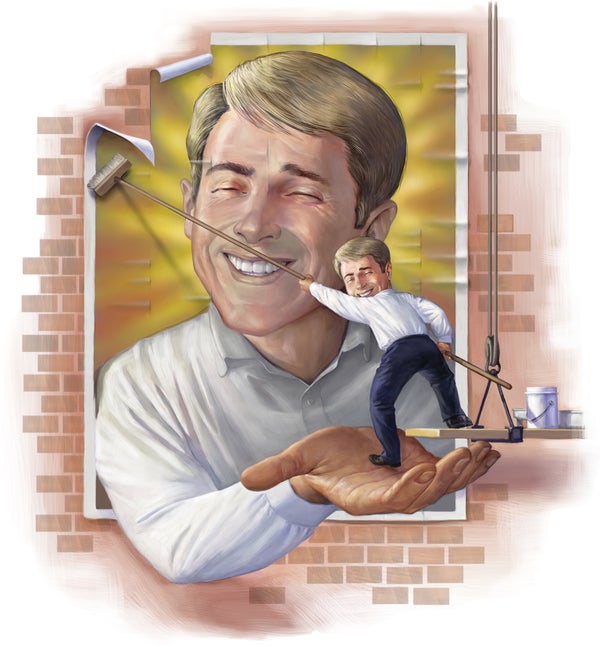
Data sets in hand, the game was afoot. The researchers crunched the numbers and found convincing evidence that pride doth not appear to goeth before a fall at all. “Unsurprisingly,” they wrote, “this is the first study to investigate temporal associations between pride and subsequent reported falls in a large sample of English older adults. Contrary to the proverb, our findings suggest that pride may actually be protective against falls rather than being a contributing factor.”
In fact, after controlling for confounding factors, the team found that “the odds of having had a reported fall ... was 19% lower for people with high levels of pride compared with those who had low levels.”
Clearly, these rigorous scientific findings raise a vital question. As the researchers themselves ask, “Do these findings undermine the validity of biblical wisdom in its application to contemporary health outcomes?” But, they point out, “the keen biblical scholar will have noted that ‘pride comes before a fall’ is, in fact, an inaccurate paraphrase of Proverbs chapter 16 verse 18, which reads ‘pride goes before destruction, and a haughty spirit before a fall,’” and that “the saying ‘pride comes before a fall’ more likely refers to metaphorical moral or ethical falls, not literal ones.”
Rendering unto Caesar what is Caesar's, how then to explain a significant decrease in fall risk with feeling proud? The authors of the BMJ paper give it a go: “In the case of pride, higher levels are likely to be reflective of, or a driver of, higher levels of general subjective wellbeing, which has been shown to have close associations with physical health. Physical manifestations of pride may also make people with high levels of pride less likely to fall—for example, having a more upright and confident posture, walking with the head raised high giving better sight of oncoming obstacles, and walking with a purposeful gait.”
Of course, these results apply only to older English people. Here in the U.S., we have the fascinating case of the now 71-year-old orange-hued man who tweeted on December 3, 2015, “I have instructed my long-time doctor to issue, within two weeks, a full medical report—it will show perfection.” Look out below.