
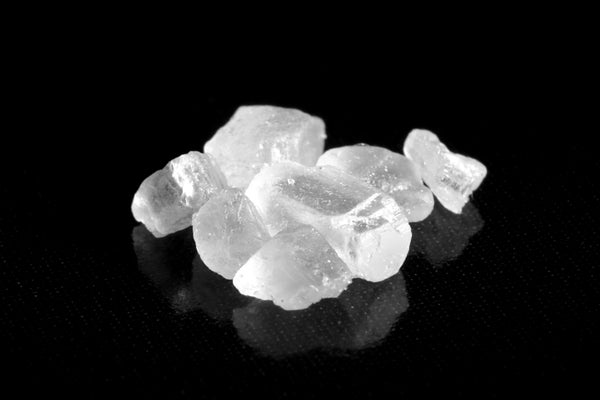

Ancient sea salt drilled from a geologic basin in Russia is providing dramatic new clues as to how Earth’s early atmosphere became oxygen-rich—allowing life as we know it to evolve. Buried deep beneath the surface for billions of years, the salt reveals surprising clues about the chemistry of the ocean and atmosphere from long ago.
The salt, excavated by an international team led by Russian scientists, is about a billion years older than other, similar geologic samples. Its age puts it smack in the middle of Earth’s Great Oxygenation Event, the ancient period in which oxygen began to dominate atmospheric chemistry. “This is a truly unique, one-of-a-kind deposit,” says Clara Blättler, a geochemist at Princeton University. Blättler is the lead author of a study appearing in the March 23 Science on the salty new samples. They are made up of minerals left behind when water evaporates. “Because these evaporite minerals are our most direct way of sampling ancient sea waters, this deposit gives us a snapshot of seawater in the interval time when we don’t really have any other direct constraints.”
Within the three-kilometer-long, cylindrical core excavated from the Russian basin, Blättler and her colleagues identified a 600-meter-thick deposit of sulfate-rich materials, including halite (aka sodium chloride)—the crystalline progenitor of common table salt. The deposit’s immense size and various trace geochemical markers, Blättler says, both suggest it formed in ocean water rather than in any freshwater source.
On supporting science journalism
If you're enjoying this article, consider supporting our award-winning journalism by subscribing. By purchasing a subscription you are helping to ensure the future of impactful stories about the discoveries and ideas shaping our world today.
Over a billion years ago, the team speculates, ocean water covered the Lake Onega river basin in the Russian Republic of Karelia on the country’s western border with Finland. Brine washing into a shallow part of the basin was trapped and eventually evaporated, leaving behind the salts it carried. The thickness of the deposit reveals the process recurred many times, gradually building up the reservoir the Russian researchers later excavated. “There’s no way you can form that much from just evaporating one batch,” says Mark Claire, a researcher at the University of Saint Andrews in Scotland and a co-author of the research.
The team’s analysis shows this ancient ocean water carried roughly 20 percent as many sulfates as are found in modern seawater. Sulfate concentration in ocean water is a key tracer of how much oxygen is the atmosphere—and how it gets there in the first place.
This is the first direct quantitative measurement of the otherwise-murky chemistry of the ocean more than two billion years ago, according to Timothy Lyons, a geochemist at the University of California, Riverside, who was not involved in the research. “What they are doing is as reliable as these things can ever be in rocks this old,” he says. The results are consistent with other, more circumstantial records left by carbon and trace minerals, he adds.
Other sulfate evaporite samples are rare. The characteristic that allows the sulfates to dissolve into water can also make them hard to find; when water washes over a previous deposit it can redissolve the evaporites, erasing the records and laying down newer ones. That means similar deposits are few and far between. Blättler says her samples clearly did not interact with much water—or they would have disappeared. “For some unknown geological reason these were preserved, and they were a little bit unexpected,” she says.
The “Smoking Gun”
Three billion years ago Earth's atmosphere lacked the abundant molecular oxygen (O2) that makes air breathable for complex life today. It was not until the Great Oxygenation Event, a mysterious transition that occurred from 2.7 to 2.4 billion years ago, that this gas—crucial to life as we know it—began to substantially accumulate in the atmosphere.
On the way to allowing life to evolve, the rise of oxygen also transformed Earth’s rocks and thus fundamentally altered our planet’s geochemistry. As oxygen in the atmosphere reacted chemically with iron pyrite in rocks, it bonded with the pyrite's sulfur, creating sulfates and other mineral by-products that gradually washed out of the rocks and flowed into to the ocean. This is why the amount of sulfate in a well-preserved salt deposit can be used to establish the oxygen levels in ancient air.
Previous research with carbon isotopes provided less-direct evidence of atmospheric oxygen, as did work done by Lyons’s team with trace metals and sediments. The new findings, however, provide a stronger connection to the buildup of the life-giving gas in the atmosphere, Lyons says. “Carbon isotopes suggest a lot of oxygen was released,” he notes. “But this sulfate is, in essence, the smoking gun of that process.”
Scientists are not yet certain how all that oxygen entered the atmosphere in the first place. Some think it may have been a gradual geologic process—possibly a change in the mixtures of gases belched out by volcanoes or the atmosphere’s gradual loss of lightweight hydrogen atoms to outer space. Others prefer the idea of a more sudden mechanism such as a geologic upheaval from planet-scale volcanic eruptions or Earth-shaking asteroid impacts. Life itself may have even have caused a rapid spike, via oxygen released by newly evolved photosynthetic organisms.
Blättler believes the new results provide a stronger case for a sudden jump than for gradual easing. “The large accumulation of sulfate that we see from our observations favors a much more dramatic transition,” Blättler says. “You have to push the system really hard to accumulate this much sulfate. It’s not a trivial amount.”
“I could buy that,” Lyons says of the quick-jump conclusion, calling the results “an important step forward” in answering “the million-dollar question” about why Earth’s great oxygenation occurred at all—and in a larger sense, why we are all here.