
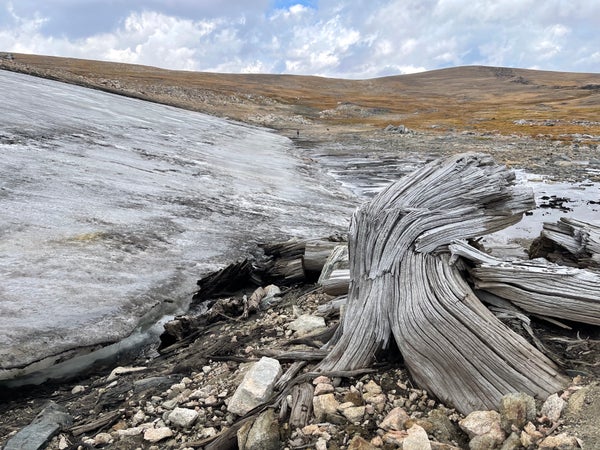
Melting ice high up in the Rocky Mountains has revealed an impeccably preserved forest, frozen in time for thousands of years.
Beartooth Plateau, which sits at an altitude of over 10,000 feet (3,000 meters), is a barren, tundra-like landscape. But it hasn't always been that way; an ancient forest lies beneath layers of ice.
Cooling temperatures about 5,500 years ago quickly encased this whitebark pine (Pinus albicaulis) forest in ice, preserving the trees in nearly perfect condition. Now, as ice patches frozen for millennia melt due to climate change, researchers are finding clues about what this ancient landscape was once like, and how it was preserved. They detailed their findings Dec. 30, 2024, in the journal PNAS.
On supporting science journalism
If you're enjoying this article, consider supporting our award-winning journalism by subscribing. By purchasing a subscription you are helping to ensure the future of impactful stories about the discoveries and ideas shaping our world today.
"No one had any idea that these patches of ice had been around for thousands of years," David McWethy, an associate professor in the Department of Earth Sciences at Montana State University and co-author of the study, told Live Science. "Things looked dramatically different than they do today."
This ancient forest of whitebark pines thrived for centuries at much higher elevations than the same tree species that can be found in the region today. This is because the global climate went through a warm period between the end of the last ice age, about 10,000 years ago, and the time when these whitebark pines died over 5,000 years ago.
This high-elevation forest was once an active ecosystem, likely sustaining animals and the humans who hunted them. From the same ice patch, Craig Lee, an assistant professor at Montana State University and co-author of the study, has recovered a wooden shaft dating back 10,000 years. This wooden shaft was likely part of a spear used by humans to hunt.

At the margins of an ice patch on the Beartooth Plateau, a forest is frozen in time.
Joe McConnell, Desert Research Institute
"We don't think about how dynamic that alpine ecosystem has been through time: people were using it, animals were using it," Cathy Whitlock, director of the Paleoecology Lab at MSU and senior author of the study, told Live Science. "You go there now and it's beautiful — it's a very dramatic landscape — but it's a little stark."
The trees likely died because of the gradual cooling of the climate at the end of the warm period described above, McWethy said. Very soon after the trees perished, a series of volcanic eruptions released ash and other materials into the atmosphere, which led to further cooling. This volcanic cooling was abrupt enough that ice quickly surrounded the trees and preserved them until the present day.
The trees revealed by the melting Rocky Mountain ice patch look "like trees that you would see up in a windswept area," McWethy said — missing their bark but otherwise pristine. Until now, the ice patch has never melted, so the ice has protected the trees from deteriorating.
A frozen forest emerging "is not something I've heard of before," Philip Mote, an Oregon State University professor who was not involved in this study, but has studied snow conditions in the western United States for almost 25 years, said in an interview. "I'm sure all sorts of things got buried under the ice."
Climate change driven by human activity has accelerated the warming of high-elevation areas like Beartooth Plateau. As more ice patches melt, there is the potential to learn more about the past, but Whitlock said these discoveries are bittersweet.
"These kinds of discoveries are scientifically really interesting, but they're also a sad reminder of how fragile these alpine ecosystems are to climate change," Whitlock said.
Copyright 2025 LiveScience, a Future company. All rights reserved. This material may not be published, broadcast, rewritten or redistributed.