
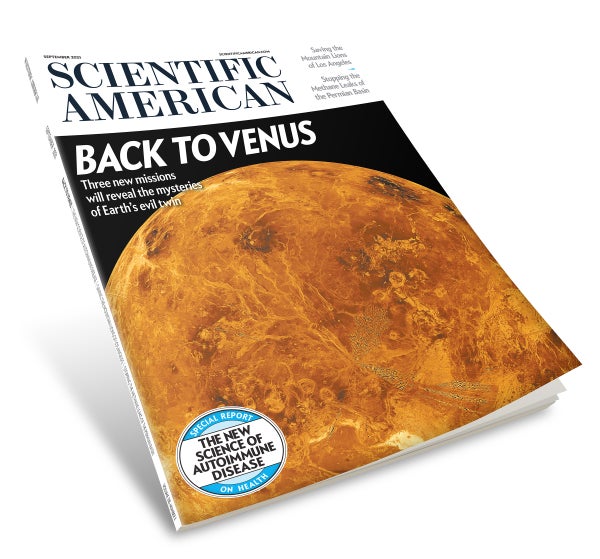
One of the things we're proudest of at Scientific American is that we've helped train some of the best science writers, graphic artists and multimedia producers in the business. Our editors frequently teach classes, guest lecture, speak at scientific conferences or universities about journalism, and commission freelance articles from early-career scientists and writers. We also host fellows and interns who work with us full-time during the summer, and we've had two outstanding writers this summer. Maddie Bender has a fellowship through the American Association for the Advancement of Science's mass media program after earning a master's degree in public health focusing on microbial disease epidemiology. Tess Joosse comes to us through the University of California at Santa Cruz's graduate science writing program (which several of us on staff attended) after majoring in biology as an undergraduate. They both have pieces in this issue. We are now restarting our year-round internship program for early-career writers, so you'll see new names every three to four months.
A few other changes: You might have noticed that our Recommended section is now two pages, up from one, and we're running longer reviews of books you might enjoy. We added two pages to the Advances section, with a regular “Science in Images” feature for an extra burst of beauty and awe in each issue.
Our special package this month on autoimmune disorders covers some of the fastest-moving and most important research being conducted today. Autoimmune disorders such as lupus, diabetes, celiac disease, Hashimoto's thyroiditis, and many more are common, and many are becoming more prevalent. Women are disproportionately at risk and often experience frustrating and dismissive care. Researchers are understanding more all the time about how the disorders begin and identifying promising new approaches for treatments.
Lots of people have strong feelings about planets. There's a long-running debate over whether Saturn or Jupiter is the most beautiful planet (team Saturn here), and of course some are still stinging that Pluto got downgraded to a dwarf planet in the Kuiper belt. The Venus people have felt neglected for decades, their favorite planet always losing attention to rover-rich Mars. But now three major missions are heading to Venus, breaking the “Venus curse,” and volcanologist and writer Robin George Andrews tells us why Venus experts are over the moon.
Venus is intriguing in part because it shows how a good planet can go so wrong. Our atmosphere isn't thick with sulfuric acid, but methane emissions are shooting up so quickly that they've become a major source of climate change. Identifying leaks of the invisible, odorless gas in time to patch them is one of the most urgent and achievable ways to slow the climate emergency. Scientific Americancontributing editor Anna Kuchment explains where the methane is coming from and how to control and even use it.
California's mountain lion populations have been divided by habitat loss and some of the busiest freeways in the country. Where the big cats are isolated, they inbreed—or don't breed at all—and concentrate genetic mutations that further threaten their future. Now an ambitious effort to literally bridge isolated populations could help pumas find one another. As environmental writer Craig Pittman reports, crews are expected to break ground soon on the largest wildlife bridge in the world. We're all hoping the cougars make a comeback.